Thursday, 17 December 2009

National Assembly's new violation of the constitution, speeding up towards total control

Updated


The National Assembly decided in the now normal chavista fashion - in a Blitz-session, at night - to approve on the first round a law that had been slummering for years and that was previously rejected by the people (as opposed to The People) in a national referendum.


Aristóbulo Istúriz, Vice-president of the PSUV and one of the two heirs apparent to Hugo of Sabaneta, said at the Assembly two days earlier that chavismo has to dismantle the powers of governors and mayors (they hardly have any now) and that Venezuela has to go to the next step on the path to socialism (don't ask me what steps he has in mind, I am still trying to find out what manual he is using).

The National Assembly decided to obey as soon as possible and approved the Organic Law of Popular Participation and Power.

Among other things, this law states that:

  • the communes, community councils and communal cities will come into force (still very vague)
  • the government of the people shall be carried out through communal councils under a model of socialist society (these blokes never heard of pluralism)
  • the councils shall take part in the planning and management of the territory
  • the government shall plan, manage and coordinate the comunes in order to keep "coherence" with the politicies of national character
  • the state has the prerogative of managing the means of production to satisfy esencial human needs (they did not state what they are)
  • the Commission of Central Planning shall be responsible for reaching the objectives of the National Plan for Economic and Social Development of the Nation
  • the Council of Communal Planning shall be in charge of planning the geographic and population distribution of a commune and of the communal development. It shall be constituted by 7 persons (don't ask me why seven, seven is a prime, seven is the sacred number of the Bible), two of which will belong to the commune


The communist councils (i.e. soviets) salute!


Ignorance is bliss. Journalists have sometimes asked the chavista Nomenklatura what they intend to do differently from the Soviets. They repeat over and over again that they are going to give power to the councils. "Soviet" is the Russian word for council and that is not just of linguistic interest. Those Soviets or councils were just a simple way of getting the power to the Party. Anyone going against the Soviets (i.e. the guys leading them) was a traitor. Here we go again. No specifics about how they will avoid the same errors.


I will analyse in future posts how these councils will be used to impose the power of the few in the context of the Venezuelan mentality. Let me be clear: this is not so much about socialism evil bad or good but about banana republic chavismo using old communist tactics.

I had already written that a huge amount of gerrymandering is planned for the next elections. The government has already reduced the budget of elected regional powers (governors and mayors) and is giving money to regions only through presidential institutions or some other institution that is "with the process". But what we will have next are a series of important transformations, more power to Hugo and his Nomenklatura and more fear for people at the moment of saying things in those councils.

This law is also a complete violation of the will of the people, who rejected a similar proposal in the Referendum of 2007. Many polls have later shown Venezuelans do not want state socialism or socialism, for that matter. Most want a pluralistic state with social democracy (which is a pretty vague concept in general but more so in Venezuela), some prefer capitalism and some socialism. But this is chavista socialism 100%. This is not so much about communism as about more power to Hugo and his high ranking officials.

Ps 1: Some information on Wikipedia German over "Soviets". The information in English is rather incomplete.

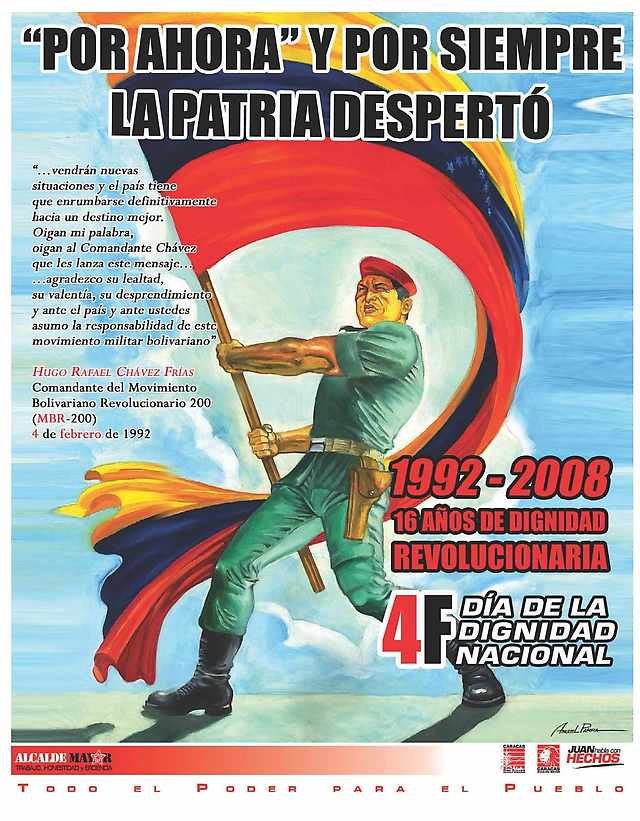
Ps 2: This is not a joke, I wrote about this some time ago. This poster is found in an Aporrea site and that muscled man is supposed to be our Líder Supremo:
Tuesday, 15 December 2009

Venezuela's future


The Economist published an interesting article about the new IEA forecasts on oil production. Although we are still making guesses on oil peaking, we know it is coming. The question is when if it is not here already. Some people - economists and politicians firstly - still seem to think oil price can solve everything and there will not be a real peak, as if oil were labor and not a finite commodity. Still, most people - geologists and other scientists first but now even economists - accept there will be oil peaking. There is only so much oil under the soil and you can only prolong oil extraction for so long. In any case, most foresee oil peaking before 2030, definitely before 2050.

Even though Venezuela has a lot, an awful lot of oil, this oil is very heavy and thus more expensive to process than what you find in Saudi Arabia or Iraq. In any case, the chances I see for Venezuela with regards to oil are roughly speaking what you see below:


Things can keep like they are now for a couple of decades and that would mean Venezuelans would get every year less and less petrodollars, but that is all. Then, sometime before the second half of this century, the world will have shifted away from oil and Venezuela will have to find something else to live off from.

If prices keep going up faster, the shift would also arrive much faster. If Venezuela does get a new really big oil boom thanks to its large heavy and sand oil reserves, it could get a lot of money for some years but the energy shift would take place much faster. Most countries won't be interested in depending so heavily on one or two countries. It is enough with the system they see now.

Venezuela is right now risking a lot. It is not Norway. There is no plan for tomorrow. There is no Government Pension Fund of Venezuela as there is in Norway. Venezuela's fund Fonden is a piggy bank for the current president to buy votes. Venezuela's population is also much large than Norway's. The end of the oil era will be more dramatic.

On the graph below you can see Venezuela's population projections until 2050. The ugly pink points are the moments when a presidential election takes place unless the president dies of indigestion.


Some important ideas I keep reminding people of (my mantras):


  • Venezuela's pupils are the worst in Latin America. They were by far the worst in mathematics for 13 Latin American countries that took part in a Unesco test in 1998. See here for more details. They were the worst of 41 countries on a test on reading and comprehension carried out by IEA the same year. The chavista government opted for avoiding any open evaluation tests. That is why chavismo rejects our proposal to bring about transparency and accountability to Venezuela's education
  • 85% of Venezuelans live in the urban conglomerates along the coast and their urbanizations are spreading across the last best agricultural areas for many plants (did you know we used to produce wheat in the XIX century?)


  • Venezuela is chock-a-block with weapons
  • Venezuelans are less productive than their neighbours due to missing skills and decades living mostly of petrodollars
Venezuelans are sitting on a pressure cooker. They know it is getting warm, but they don't really know how bad it will get unless they do something. They could, if they wake up fast, avert the worst. They could, if they planned, transform all those boiling cookers in the world into something good. But a radical shift towards accountability and transparency, lots of sacrifices and hard thinking is what they will need.

People's Ombudsman in Venezuela


Gabriela Ramírez is Venezuela's main People's Ombudsperson. Her work is to defend the People.
She has been doing that work since December 2007. She declared yesterday that protester Brito, who has been on a hunger strike because of what the state has done to him, is suffering from mental problems and that is why the government took him away from the OAS building to a military hospital to force-feed him. Already Miguel has written about the Brito case here. Dutch Alpha (in Dutch!) wrote a lot here. I wonder how many other persons will get mental problems in Venezuela these days.

Gabriela Ramírez was the one who also said during people's (not People's) protests about violent crime in Venezuela that "it is just a sensation created by the media". So, the highest murder rate in South America is just a sensation. The government rejects any open debate about that or any issue because they are not on the same league as us, the people.

Gabriela Ramírez is the same person who said in August of this year that she supported Attorney General Luisa Ortega Díaz in her proposal to introduce the Law Against Media Crimes (the outcry was so big that they had to dish it away).

That is the People's Ombudsman in Venezuela.

Sunday, 13 December 2009

Our parents used to eat this


The Common Opossum (Latin Didelphis marsupialis), Venezuelan Spanish Rabipelado (Naked Ass) is one of the most common mammals you will see in Venezuela. This marsupial is a relative of the Virginia Opposum, but this is the Latino version, as you can see from the map.


These animals are as ugly as the night and look like a mutant rat but my dad used to eat them as a child, as most rural people did in Venezuela (and the US with the V. Oppossum) some decades ago. My aunt tells me they did not taste that bad, but I have to say the times I saw these animals in the wild I was not hungry at all.

Saturday, 12 December 2009

Hugo wants 30 years for Eligio Cedeño's judge

Quico wrote some months ago about the Eligio Cedeño case. You should really go to that article first if you haven't read it, before continuing.

2007
Cedeño was a wealthy Venezuelan banker. As Wikipedia says, he was "arrested in a crack down by Venezuelan officials on individuals circumventing government currency rules to gain US dollars". As you may know, Venezuelans cannot freely buy foreign currency: there are quotas for normal citizens, there are quotas for importers and bankers. This has lead to a huge amount of (extra) corruption in the system, well-connected people have made fortunes. Blogger Miguel (Devil's Excrement) has written a lot about this.

In any case, the banker was detained and put in prison (in El Helicoide) without charges, as Quico's informant some months ago said.


El Helicoide

He may be guilty, but the whole process was completely un-kosher. There hasn't been any concrete charges for over 2 years. Judge Jury López, who was in charge of the case, fled to the US from Venezuela and got a refugee status after claiming she was first put under pressure and then threatened. Above you have a video of hers in Spanish only, here a shorter part with subtitles.

2009

Quico wrote Boliburgueses (like Arné Chacón) are now living under the shadow of Cedeño. Now Arné and some other Bolivarian bankers are in prison but last Thursday 10 December the newspapers announced judge María Lourdes Afiuni had liberated Cedeño. She ordered him (wishful thinking at best) to remain in the country and report every 15 days. The same day the Venezuelan Intelligence Police went to look for him in his appartment and elsewhere.

On Friday 11 Hugo of Sabaneta asked for the judge to get 30 years prison for letting the banker run away. I know nothing of law but to me it is strange a president can publicly ask for that punishment (the maximum amount of years anyone can be in prison in Venezuela) because a judge liberated a man who may have stolen money.

In any case, today the judge was detained and was brought to the Palace of Justice.

There have been several rumours about why Eligio got such a harsh treatment (at least so early), while others were left so freely. Some point to Hugo's daughter.


Venezuela plays

Good article by Rory Carrol, from the Guardian, about our Sistema.

Actually, "this thing with music" predates the Sistema, even if it has undoubtedly helped a lot. Already Alexander von Humboldt noticed on his visit to Venezuela a marked predilection for music, which is greatly cultivated, and which (as always results from a taste for the fine arts) brings the different classes of society nearer to each other.

One of the things I miss of Venezuela is the spontaneity and casualness in which classical music is enjoyed. Listening to Brahms or Rossi, Bassano or Jean-Marie Leclair is not just something for some posh elite or for the elderly. It is for people from every group of society. That is the only way it should be.


A difference I always noticed between concerts in Venezuela and Europe (apart from the way people dress): Venezuelans will really applaud according to how they liked it, not more and not less. We have no mercy in that respect...but it is because we love music.


I also wrote something further about El Sistema and science in Spanish here. That is something we have develop now.

Thursday, 10 December 2009

EGO, HVGO


HODIE, HVGO SABANETAE, PRAESES VENETIOLAE ET EXERCITVS ORDINVM CENTVRIO, AD DIEM XXVII NOVEMBRIS CELEBRANDVVM DIEM FERIAE DECLARAVIT.

AMICI CENTVRIONIS DIE XXVII NOVEMBRI ANNO MCMXCII CONTRA REM PVBLICAM CONSPIRAVERVNT. VTIQVE QVINQVAGINTAM PERIVERVNT.

HVGO DIE II FEBRVARII IPSO ANNO MCMXCII VT EVERTERET CIVITATEM STATVIT. DVODECIM MILITES MORTVI ET MVLTI CIVES VVLNERATI SVNT. II FEBRVARII A ANNO MMIX QVIA HVGO HIC DIXIT ETIAM DIES FERIAE EST. LABORARE NON LICET.


-----> HIC HISPANICE