Showing posts with label autocracy. Show all posts

Wednesday, 17 March 2010

The joke: Venezuela's charade of a democracy


Hugo of Sabaneta keeps taking away powers from any form of elected government that is not under his control. As Venezuelans rejected his proposals in the 2007 referendum to create parallel regional governments and to introduce the figure of special "vicepresidents" (i.e. viceroyals) to regions, Hugo decided to push through said proposals anyway by using special powers given to him by his Assembly.

Now Hugo created a Federal Council to have a better control over the states. Although most municipalities have mayors that are pro-regime, around 45% of Venezuelans live in municipalities with opposition governments (never mind those goverments have less and less to do by the day).

Elías Jua, vicepresident and one of the key figures of the regime, has just announced what mayors are going to represent each state in this new Federal Council.

You can see the municipalities of those mayors in the map I created here: the winner takes it all and all those representatives are absolutely loyal to the former coup monger. The reddish areas have chavista mayors, the blueish have oppo mayors and the yellowish "discidence mayors". The green spots represent the mayors now in that council. They are all in the reddish regions. They will manage a lot of the moneys Hugo decides to give back to the states. The oppo mayors will have to beg to them.

In the following months you will see how chavismo will use any legal and illegal measure to prevent the opposition from gaining many deputies in the National Assembly, how it will bring electoral fraud to new levels of sophistication and how it will, eventually, emasculate the National Assembly to prevent the opposition from gaining any power there.

The Carter Centre, mostly IT illiterate, thought fraud was when you had soldiers pointing at you with an AK47s, telling you how to vote. They did not see that in Venezuela, so they thought things were kosher and they keep being as they were in 2004. Things are a wee bit more sophisticated than that, as the Smart Machines and the weird paper trails have shown.

I wonder if the EU is again going to send EU observers who will only follow the election from their hotel rooms or if the Venezuelan regime will simply invite those "EU observers" that love to have pictures of theirs taken with the comandante. Vamos a ver.


Saturday, 6 March 2010

How not to become a developed nation

This post is about the Bolivarian militias and Venezuelans in general. This is about Venezuela's future or lack of it.

Some weeks ago I was listening to a BBC programme about the Basij, the paramilitary militia used by the Iranian regime to oppress its population or, as the Basij and the regime say, to "defend the revolution". I could not stop thinking about Venezuela.

The BBC interviewed people who had been victims of the Basij and also a former Basij. The stories were gruesome and although they were nothing really new, they kept being shocking. The human rights situation in Iran is as grim as ever.

There are important differences between Venezuela and Iran. One of them is religion. Venezuelans usually have a rather light view on religion. They are mostly Christians, sort of. They don't tend to mix politics with religion, even if the current president keeps telling them about how Christian he is and how socialist Jesus was. Venezuela, unlike Iran, was a democracy before the so-called revolution arrived. It was a highly dysfunctional democracy, but a democracy all the same. People were used to speaking out very loud about. As I said on an earlier post, there was no real culture for civilized debate. Still, there was a start.


This is Iran


This is Venezuela


This is Venezuela


The Venezuelan regime could not change that overnight and it did not want to do it. The new government did not want to alianate at an early stage potential supporters abroad and in Venezuela. They let international observers go to Venezuela. They let them see how Globovision was telling day in, day out about how dictatorial the regime was. A dictatorship just doesn't do that. The chavista government wanted foreign observers to see the very harsh criticism of a few national newspapers. Government officials know most international observers ignore how many persons could actually watch those TV stations or how many normaly read those newspapers.

Globovision is a Potemkin village for the Venezuelan government. It broadcasts its very critical view but it can only reach a tiny minority. In reality we can say Venezuela now is no longer a democracy. It is not a Belarus nor an Iran, but it is not a democracy. The opposition can bark, but the rope is short. And here I go to Venezuela's similarities with Iran:
  • both countries have governments that claim to be revolutionary,
  • both governments are cooperating very closely
  • both governments refuse to have an open, fair debate with the opposition (they insist the debates are taking place everywhere)
  • both governments use anti-US feelings to rally people around themselves and to distract from domestic problems
  • both governments rely heavily on oil exports and
  • both governments know developed nations rely on those exports to move their engines
I will also mention other similarities that English-speaking news outlets fail to mention:

  • urban, well-educated people are highly disconnected with the rural areas
  • rural areas as well as those living in secondary cities have very little sources of information beyond the official media

The development of the so-called "Bolivarian" militias is a worrying phenomenon.

One of the British journalists started to mention the typical characteristics of many of those Basij in Iran. The similarities were clear, even if not surprising. Most members of the Iranian militias

  • are of rural or sub-rural background
  • are poor
  • have very limited education
  • feel forgotten or despised by the rich and the well-educated urbanites
  • are deeply religious
Many of them want a real job and access to education.


Venezuelans are, as I said, not that religious. Their believes have nothing to do with becoming a martyr and going to heaven in martyrdom. Still, many of those who are still supporting the government and are not part of the high "caste" of boliburgueses have the same characteristics as the members of Iran's militias. About half of Venezuela's population, by official numbers work in the informal sector. That informal sector is not so much "electrician working without receipts" but rather "street vendor selling foreign toys on the streets". Many are depending on some sort of scholarship for doing almost nothing. The vast majority have a very low level of education.

While most (definitely not all) opposition leaders keep bickering in the posh areas of Caracas, Maracaibo and Valencia about who will be the candidate there, people elsewhere are left unattended. Many are craving to listen politicians about an alternative to the current regime. Most national leaders of the opposition just remain in a couple of cities. If some go elsewhere, they just do it very briefly, give their talk and go away. They do not listen.

While the regime is losing popularity, the opposition is not gaining ground outside the 3 main urban hubs, not even in the dormitory cities around those urban hubs. It is not easy: the opposition does not have the financial resources the government has and when it has tried to reach people in places in new places, its people have been brutally attacked. Still: it must keep trying and it must do it as a united front. The opposition needs to put down roots in those areas.

Meanwhile, the chavista regime wants to increase control there. It knows it cannot survive in an atmosphere of pluralism and civilized debate. Its leaders come mostly from those non-urban areas where the current opposition is weak, so they know how to use the situation of people living there. Not only do they have the access to petrodollars to pay for training, they give those people a feeling of belonging. They provide fun. They give them a mission. They let them feel important and they wash their brains. They talk a lot about Bolivarianism almost as a religion, - never mind their image of Bolivar is absolutely ahistorical. They know how to tell stories that lull.

Some people within the opposition underestimate the danger of those paramilitary groups: the first pictures of those militias show people holding rifles the wrong way, pretending to use weapons that are not loaded and the like. But people forget: it is much easier to learn how to destroy than to learn how to build.

The opposition will sooner or later discover the rural and above all the secondary urban areas. They have to: almost half the population lives in those secondary urban areas. The thing is how it will be able to compete and campaign fairly there. The opposition will find networks of people who think to be defending some revolution even if they are just defending a reactionary regime. The opposition will find people who have been brainwashed but who feel they have been taken seriously for the first time in their lives. The opposition will find armed people, people who have a salary as guerrilla. They will find people with a contradictory ideology, but an ideology all the same, more than what most opposition parties can claim to have.

The whole situation is very sad. The government is spending large amounts of money and time in training Venezuelans to become guerrilla fighters against their own compatriots and a US intervention. Instead it should be training them to become mathematicians or farmers, electricians or mechanics specialists.


Take the development of the 'Bolivarian' militias and combine them with the Venezuelan soviets, the consejos populares, and you have a recipe for disaster and lost decades.


On another post I will talk more about the consejos (or Venezuelan soviets). Daniel Duquenal already gives a good account on them and what is awaiting Venezuela.

Further information on Iran:
English
here.
German
here

Saturday, 20 February 2010

The time bomb and the minefields in Venezuela

Venezuela can get to the level of low-flame civil war or enter into a period of very open repression in six months to one year at most.

I don't think I say this lightly. Here you can listen Chávez stating that they will rule for 900 years. The government does not understand such a thing as "pluralism" or "open debate". As you can read from governmental sources, they do not even consider there could be something like a power change. They may say "it is because the opposition is no opposition, it does not live up to the challenge". Everybody knows it is not just that. Chávez and his high-ranking supporters would simply never accept losing power. They are either

  • too involved in crimes of all types AND/OR
  • too imbued in an absolutist ideology that does not accept anything but total contro, power alternation is not an option for them, who claim to be "the People"
As the economy deteriorates and the disatisfaction grows, the government can only threaten, increase control of the electoral system, of resources, move more potential enemies to leave the country as in Belarus or Cuba.

The government has distributed many thousands of Kalashnikovs and other weapons among its militias for some years now. In January of this year the National Assembly approved the new law about "Bolivarian" militias. The military has been training those militias with more or less rigour for some years already. Now they don't just have a new name, they are going to be scale d up.


If you click on the picture you will go to VTV, the governmental national TV site. There you can read about the "Bolivarian" militia, you can watch the president and a young woman in El Pao, in Northern Cojedes.

This woman is one out of 2000 persons (180 of them women), mostly from rural, poor areas who were spending three days in paramilitary training. This lady is an average Venezuelan. Most Venezuelans don't live in "the countryside", but they do live in cities that are anything but urban when it comes to available services and opportunities.

She is poor and her education is minimal. She has probably never left the country and has no ways of comparing things but what she gets through some filter. She has hardly any memories of life before 1998 and if she has, I am sure the pieces relating to previous governments are not good. Venezuelan governments had grown more and more ineffective with the years and rural areas had become more and more forgotten.

The national government is telling these people they are preparing themselves for any US invasion or attack by any US-supported movement. It is brainwashing them in a way that can only be compared to that of evangelical fundamentalists.


It does not help us at all that the most vocal opposition in Venezuela are people like this:
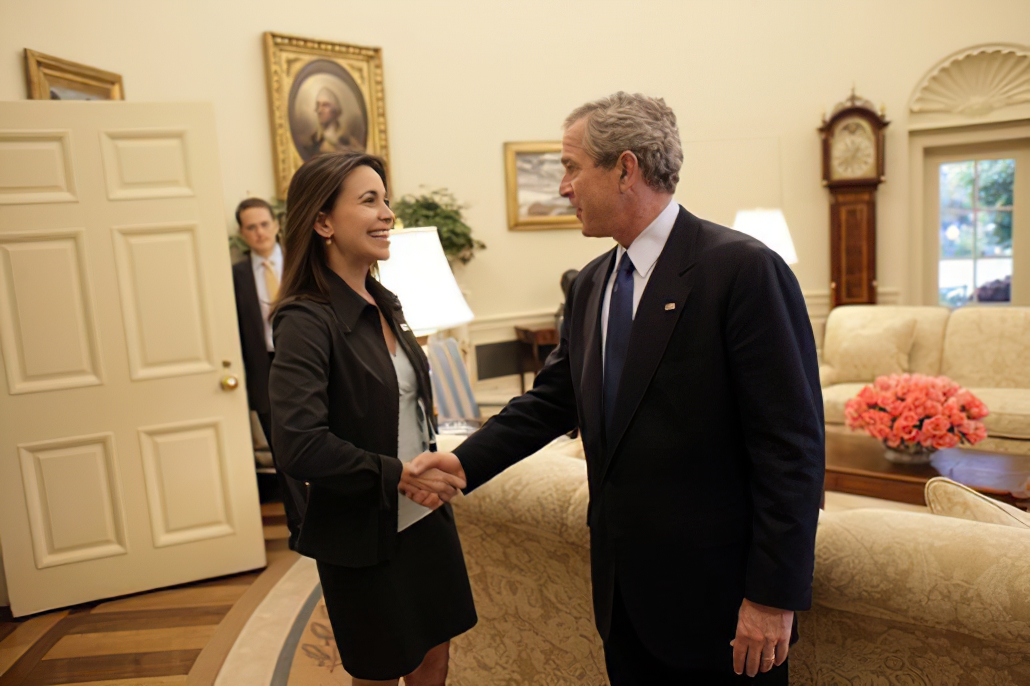


That is Ms Machado. She did a good job for Súmate. Still: it is not just a fatal picture with the wrong person. You just have to listen to her while trying to imagine how much time she has spent listening to people in El Pao, in El Tigre, in Maturín, in Pedernales, in big Miguel Pena or Libertador. She is running just to become a deputy for the most prosperous electoral district in Venezuela. Well, somebody has to do it and yet: a lot of people are putting most of their hopes, efforts and attention on stuff like that.

It does not help another of the most vocal leaders the opposition has right now is a guy like Ravell, with his FOX-News kind of journalism, who often goes to the US on vacation and to see his family there. Let me be clear: 1) FOX News journalism sucks and it isn't much better than VTV journalism and 2) although there is nothing wrong with going to the US or Europe on vacation, the vast majority of the people in Venezuela want to see leaders who are more grounded in Venezuela. They want to see people who have spent more of their free time talking to the average Venezuelans, not to the average inhabitant of a posh area of the capital.

It does not help that the few opposition leaders who are not from the capital's Eastern side are hardly heard anywhere.

The government has a couple of advantages:

1) the general level of education is very low and brainwashing is particularly easy, easier than in many other countries in South America (check out my posts on education)
2) most opposition leaders are indeed out of focus, they don't work outside their main 2-3 urban centres and beyond the TV cameras, they have no project or they don't know how to dissemiante their projects
3) the petrodollars will keep flowing
4) governments such as the Spanish government will keep supporting the Venezuelan regime as long as it gets juicy business deals (sure, and "promoting a climate of dialogue and understanding")
5) the far-right will find its way to promote extreme, undemocratic solutions, just like the far-left, to the detriment of most people, they will also be the ones helping the current leaders of the opposition

Social inequality was very high in Venezuela and things aren't getting any better. Now, though, the government in power knows how to do very effective brainwashing. Tensions will increase. The opposition is lead by people out of touch with the Venezuelans outside the Eastern Caracas cocoon. Groups challenging for an open, fair debate will be either rejected or ignored. Stupid people will try to promote violence and fear.

There are lots of weapons out there. There is some form of ideology - contradictory, rather superficial and all, but much more consistent than what the opposition groups offer -. There is resentment. There is ignorance.

We have a ticking bomb. We have minefields. We need courageous deminers.


Thursday, 4 February 2010

Violent coup mongers celebrating themselves


On 4th February 1992 there was a failed but bloody coup in Venezuela. The country had been spared the kind of military dictatorship that had afflicted other Latin American countries in the sixties, seventies and eighties. Still, Venezuela was not free of the military plague.

After so many years of corruption and mismanagement, the living condition of people had been worsening and tension grew. Middle-level military thought their time had arrived and they went in for that coup. The conditions were there: millions of Venezuelans, very naively - and I would say very stupidly - had voted for Carlos Andrés Pérez in 1988. He had been president once before, in the early seventies, when oil prices were high and population much smaller. He got elected in 1988 because people thought Pérez would get Venezuela back to the "Saudi days" of the seventies. That was not possible with the Venezuela (and oil prices) of 1988. He tried to implement some policies by the IMF and he acted very badly when communicating them. One of the first steps he took was to increase prices of petrol. Almost all Venezuelans think they have a birth right to stupidly cheap petrol prices (the cheapest on Earth). Riots followed. The government, supported by the military, used forced and killed many people.

The strange thing is that Venezuela's current government, a government that claims that the 1992 coup was partly motivated by those killings, has not been able after so many years to present a report on the issue. They claim there were "between 300 and 5000 people who were killed". I think we know more about some Greek-Persian wars than about that event. It is very curious because most people in Venezuela do have a family and you cannot just "disappear" so many people in just a couple of days without having family members reporting that. Still, they say "300 to 5000 people". There are no reliable lists. There are hardly any accussed as most of the responsible were in reality military, military who are now with the man in power. The current government cannot explain how they can justify a bloody coup in 1992 because of an event that happened in 1989.

Carlos Andrés Pérez was a highly corrupt man and yet his government was going to end in 1994. Back then the presidential system in Venezuela did not allow for immediate reelections.

In spite of all that, Hugo Chávez and his thugs carried out the coup, murdered many innocent people and ended up in prison because Hugo Chávez at the end was afraid for his life and gave in (he justified it because he did not want to shed more blood, but it was rather his, the other coupster elsewhere were already in control). Some months later another failed coup shook the country. One of the coupsters was Arné Chacón, the brother of the former miniter Jessie Chacón. In 1992 Arné Chacón said on TV during the coup that they were taking over because of the corruption of the government of that time. During the last few years Arné Chacón became one of the richest men in Venezuela. The situation was so blatant and it was getting so embarrassing for the regime that Hugo had to put him in prison. His brother stepped back as minister and is keeping low profile, he says he knew nothing about what his brother was doing, even if street cleaners seemed to be pretty aware of it. But there are still lots of boliburgueses at large.

Today the Venezuelan government is celebrating the initial coup. They are spending a lot of time in marches because, apparently, the people in there do not have to work. This reminds me of Cuba, where a large group of the population has no other work than to go to marches and spy on their neighbours.

The Venezuelan government is even wasting Venezuelan money by celebrating this coup in European capitals where coups against democratic countries are not usually celebrated. Here you see an invitation in French to go today to the Venezuelan embassy in Brussels:


(snatched from another Venezuelan blogger, V.)

"the morning of 4 February 1992 marked the breakup between the State and society due to a government sunk in corruption and subservient to the interests of foreign powers. This set up the basis for a military rebellion and the emergence of a national leader, Hugo Chávez Frías, thanks to whom the Bolivarian revolution was born".

So they are celebrating right now a coup against a government that was elected by the people and that was going to be over two years later anyway. Their excuse were the crimes said government committed two years earlier, in part backed up by the military. I always disliked the government of Pérez but I definitely cannot justify a coup. I still remember the shootings back then. I was living in a student residence close to one of the places the coup mongers attacked in San Bernardino. I still remember the destruction I saw on several buildings. I still recall the fear in the eyes of the people. I still see the pictures with the corpses of the innocent murdered by the the military under Hugo's command.

The saddest part is that right now corrruption has increased much more and involves most of the high ranking officials in power, foreign powers are more present than ever in Venezuela and the country is much more dependent on oil exports than ever. Apart from that, the murder rate has more than tripled, hundreds of thousands of Venezuelans have left the country running away from crime and political mobbing and we have one of the worst cases of personality cult in the world.

The joke of the 1000 years in Power

Thanks to Dutch blogger Alpha I saw Hugo of Sabaneta has just now said he thinks the revolution will last for 900 years and he may rule for 10...or perhaps 20 more years...but "20 may be too much, wouldn't it?". Those in the public shouted "no". Isn't this like some kind sick relationship between a harassing man and his beaten wife?

Shame on all those who support this regime.

PS: I still haven't got a response from the Vice-president of the European Parliament on my questions. Oh, I will keep demanding that he answers. He is an employee of the European Union.


Saturday, 30 January 2010

The Ones In Power


UPDATED


This is a little mindmap representing some of the top guys around Hugo of Sabaneta, a few details about them and some relationships they have with some figures.

Vicente is too old to become too much of a public figure or a possible successor to Hugo, but he still pulls a lot of political and economic strings. Diosdado is, apart from Hugo, the most agressive, even if Aristóbulo is becoming more so. Aristóbulo seems like the "less unkosher" of them all (the one with less links to the wealthiest), as far as I know. He was an active politician of the IV Republic, though.

If you have more details, please, let me know, preferably with references.


Here the first update of the poll about when readers think Hugo will cease to be Venezuela's head of state. This is far from scientific and there may be readers who tip on what they think and others on what they want. Still, I think we can get something interesting out of this.

There were more readers answering this time.

In general:

  • there were more readers answering
  • the percentage of those who think Hugo will leave office after 2020 has increased meaningfully (8.5% to 23.1%)
  • the amount of people who think Hugo will stop being president of Venezuela this or next year has increased very lightly (21% to 24.6%)
  • last time there were 65 respondents (hopefully we will have more this month)
I am curious about how numbers will develop this month.
So, please, readers: when you are ready, just give your gut feeling about how long you think the Líder Supremo will be president of the country.

Sunday, 24 January 2010

I am the people, I demand absolute loyalty: 1, 2, 3

ONE

On 23 January 2010, Hugo Chávez said the following:

"those who want fatherland: come with Chávez..."
"I demand absolute loyalty to my leadership."
"I am not me...I am a nation (un pueblo), I am not a person, I am the people"
More here:


And just now TV station Rctv (available on cable only) has been taken off the air once more.

TWO


Miguel Ángel Martínez, PSOE politician and vice-president of the European Parliament said some weeks ago that "the vision people have in the European Union about the process taking place in Venezuela is not real" and "the idea about a monopoly on information [in Venezuela] does not correspond with reality" (here in Spanish). I have decided to send him a link to this post.

I have some questions.

1) I would like to know from Mr Martínez if he is aware of the fact that less than 30% of Venezuelans can watch government-critical TV channels in Venezuela: those in the capital, those like Mr Martínez who stay at a posh hotel room on a diplomatic visit, those in Valencia or those who have cable TV (a minority in Venezuela, which is not Europe).

2) I want to know if Mr Martínez can tell us whether the Venezuelan opposition can speak out freely in state TV channels or if those state channels are to be used only by the government for its propaganda all the time.

3) I would like him to tell us if he is aware of how many hours a week TV and radio stations are forced to broadcast the president's speeches, among them those full of very vulgar insults against the opposition (just one of many examples here).

4) Does Mr Martínez know how many Venezuelans read newspapers and what the circulation of regime-critical newspapers is?

5) Does he know that Venezuela's president does not accept to have an open debate with anyone from the opposition, not even in election time, and that no critical journalist can even get close to him?

6) Last but not least, I want Mr Martínez to say something about the video above. Perhaps "No comments, those are internal matters"?

I will let you know what he answers.


THREE

Last August a group of very well-known thugs supporting the government attacked TV station Globovisión (a sort of worse FOX News, but still the only thing still critical to the government on TV). The leader of the attackers, Lina Ron, was caught in fraganti by many cameras. As the attack was undeniable, the president had to state that Lina had to go to prison. Rory from the Guardian wrote about the event here. Her detention was just a farce. As the opposition thought, she was free again in no time and she was just next to her Líder Máximo on this latest event. You can see the peroxide blonde here:


Thanks to Alpha, who has an excellent post in Dutch here


PS: Mr Martínez still hasn't replied

Sunday, 4 October 2009

Venezuela's murders and fighting poverty according to Chávez

Right now Hugo Chávez, is forcing all radio and TV stations in Venezuela to broadcast his message, as he does for hours every week.

He is saying he swears "on his life that we (i.e. he) will defeat poverty by 2019". He also says old parties AD and COPEI won't ever come to power again in Venezuela. It is interesting he says this about parties that were - although very corrupt and inefficient - at the very least as democratic as Hugo's party. He does not say his family was in the COPEI party before he carried out his bloody coup attempt in 1992 against a democratically elected government (at a time there was no possible reelection).

Chávez says the opposition will never come back to power because it has no proposals. I wonder what Sarah Wagenknecht and other European deputies from the far left have to say about this.

He doesn't say that when his government came to power the price of the oil barrel was $12 and it had been very low for over a decade. He does not say the average income for higher oil prices in Venezuela is this year still over 300% that of 1998 (in 2008 over 1000%), which means a lot for a country where 90% of foreign revenues comes from oil and where almost everything is imported. He would not say this as people would do the maths and they would realise his government has just given crumbles to them and he has reserved the best for the red boliburguesía. He does not say Venezuela stopped taking part in open evaluation programmes of education when he came to power. The man who told Bbc journalist Lustig in 2004 that he had dramatically reduced crime in Venezuela does not say his government stopped sending data about the murder rate to United Nations in 1992.

So, he definitely does not say the murder rate, which affects mostly the poor, has risen from 19 murders per 100000 in 1998 to over 70 murders now, more than in any other country in Latin America including Mexico.

Here you have the updated murder statistics for the Carabobo state since 2005 . Things are similar or worse in other regions of Venezuela. I just take the statistics of that region because it is easier to collect the murder numbers from Notitarde, a newspaper in that state that has a working search function. Notitarde started to publish all murders per municipality in 2006, so from then on you see a different colour for each region of that state. It is impossible to make them up. They write down the names of the victims, the ages, often the pictures...and you can just go to the morgues in the region, mortuaries that are all the time full.

The Venezuelan police has more agents working as bodyguards protecting chavista politicians than on the streets trying to protect people like you and me. I have already written that even according to official statistics a Venezuelan policeman is 150 TIMES more likely to be a criminal than the average Venezuelan citizen (officials provided the basic numbers, they just did not do the maths). It seems the only people they protect are high ranking chavista officials. I suppose they have to. Venezuelan "socialist deputies" earn net more than euro-deputies whereas a normal Venezuelan teacher cannot live from her salary alone. Now you can figure out how the president of Venezuela wants to defeat poverty.


PS: Please, if you haven't done so, it would be great if you answer the two questions on the right: what is your mother tongue and what topics you want to read more about.
Thanks

PS2: For an update of the government's attacks on democracy, always go here.

Monday, 11 May 2009

Chavez a step closer to Mugabe


Yesterday Hugo Chávez threatened again regime-critical TV channels (Globovision) and newspapers (El Nacional, El Universal and a couple of other minor ones). He also announced a new wave of land expropriation in Barinas. As I have written earlier, expropriations of all kinds will increase in the measure Venezuela's economy deteriorates. It is incredible how we have come to this point even though the oil price is still a couple of times more expensive than in 1998, when Chavez was elected.

The Barinas strongman won't expropriate lands of his political fans, much less those of his family, which is one of the biggest landowners in Barinas. He will just go for those who oppose him. The interesting thing here is how he declares the amount of acres that need to be expropriated, which shows how little he cares for legality: 10.000 hectares have to be taken over.

Expect professional squatters and his military people to end up with the best of those lands.

The picture below shows the entrance to La Chavera, property of the Chavez clan. The president's family has much more than that hacienda, but most other properties are under the official name of front men.

Monday, 16 March 2009

Chavez's march towards...


absolute control has picked up steam.

Most people abroad are already aware Venezuela is heading towards less and less democracy and yet they are not aware of how serious the situation is becoming. Let's put some perspective.

We got local elections last year and even though Chavez's party took away most states and municipalities, the opposition managed to win states or municipalities where 45% of the population lives. Some of the largest slums in Venezuela (and Latin America) like Petare, actually voted mostly against the pro-Chavez candidate.

What has happened? Well, apart from the fact Chávez pushed for a referendum to lift up the term limits (this in a very strong presidential system), something for he had the government spend 12 billion dollars in "social programmes" (actually giving away free food and similar things and nothing about sustainable development), he has increased the speed in which he is taking away the few powers the opposition had. Among other things,

  1. The local governments where Chavismo lost made important money transfer to the central government just before stepping over, leaving the incoming mayors or governors with much less money than expected
  2. The pro-Chávez mayor of Maracaibo transferred on the last minute the control of Maracaibo's underground to the central government
  3. The national government issued a decreed to transfer public hospitals from Miranda state to itself
  4. The national government took over the local TV channel Ávila, which was under the control of the Caracas mayor (now opposition)

Now the central government declared it was taking over harbors, airports and motorways of Zulia and Carabobo, where the opposition has been trying to "govern". Those harbors, airports and motorways used to bring most of the money for those states. Both governors have declared they would oppose the take over and Chávez has threatened to take them to prison.

And some people abroad were saying the gains the opposition got in the last elections were a chance to prove how they could govern.


Monday, 12 January 2009

This is NOT a joke


As El Nacional tells us today, the question that the National Electoral Committee will present for the referendum to allow the indefinite reelection of Hugo Chávez (i.e. the indefinite reelection within a very strong presidential, not parliamentarian system of the president and since shortly, mayors and governors) is the following:

"Do you agree with the amplification of the political rights of Venezuelan women and men in the terms established in the amendment of articles 230, 160, 174, 192 and 162 of the Constitution of the Bolivarian Republic of Venezuela, proposed by initiative of the National Assembly, so that the postulation for all public posts is allowed in order to make their election exclusive expression of the people's vote?"

Chávez really is afraid to lose. He is really in a hurry, as Quico writes.


Question in Spanish:
"¿Aprueba usted la ampliacion de los derechos politicos de las venezolanas y los venezolanos en los terminos contemplados en la enmienda de los articulos 230, 160, 174,192 y 162 de la Constitucion de la Republica Bolivariana de Venezuela, tramitada por iniciativa de la Asamblea Nacional al permitirse la postulacion para todos los cargos de eleccion popular de modo que su eleccion sea expresion exclusiva del voto del pueblo?"


Tuesday, 23 December 2008

The minister of Foreign Affairs of Venezuela and more lies


According to the Venezuela (i.e. Chávez's) state radio, over 50% of Venezuelans abroad have signed to support Chávez's new attempt to introduce indefinite reelections in our very strong presidential system (a system that is very different from the parliamentarian systems where there may be no limit to reelections but where prime ministers have just a fraction of Chávez's powers).

That number is a blatant lie.
If you check out the voting patterns for Venezuelans abroad you will see we are by far against Hugo Chávez. No, most of us are not "white plantation owners", as some in the extreme left want to portray us, but mostly professionals from every sector of society who got fed up of violent crime and political mobbing in Venezuela.

In 2006, Chávez got 24.47% of votes abroad whereas he got 62.84% in Venezuela.
Are now Venezuelans abroad suddenly more Chavistas than in Venezuela? Why did we decide to go out in the first place as Venezuelan emigration is rather a recent phenomenom?

We all abroad should put pressure on our embassies to make them present the numbers for each country. If lies like this start now, let's see what these people have in petto for the referendum proper.

Saturday, 2 August 2008

Hugo Chávez's new assault


Hardly any foreign news outlet payed attention to Hugo Chávez's latest assault against democracy: the enabling power he got from his National Assemby wad going to be valid until 1 August 2008 and he decided to wait until the very last moment to introduced 26 new laws more. Very strangely, these new "laws" were not really published in the official gazette of the nation. Only the titles of the laws were revealed.

Probably, Chávez servants and he are still editing the laws and trying to expand them as much as possible, but they decided to publish the titles already because they think that in that way they can still make them valid through the enabling power which finished yesterday.

We only have this:

1) they have not been discussed in public at all, the public is just getting the news
2) they were announced at the very last day of the period in which Chávez had his enabling power
3) the only source of information available are the titles of said laws and the references to things Chávez wanted to accomplished with the proposal for constitutional reform Venezuelans rejected last year in a referendum.

From the titles and what Chávez had hinted already with the proposal we rejected, we can guess the following:

  • Hugo pushes for the further development of some socialist militias, which are likely to be the armed paramilitary that will protect his persona in the future, when he will refuse to accept he no longer has the support of the people
  • Hugo's uniform will have 4 "suns" instead of 3 as "Commander in Chief" of the Venezuelan Army. With this, Chávez gets to the same level as Fidel Castro, the one head of state in Latin America who until now had a higher military rank than any general
  • Among the new laws there is (again) one about Housing and Habitat, one about Security and "Food Sovereignty", another one for tourism, one (a new one, after another one published a couple of months ago) about maritime spaces and one about the defense of people to have access to goods and services, whatever that means. There is also a new law about a new law regarding the "Bolivarian Army".
  • The Supreme Court decided, just hours after the title of such law was published, to declare it is "constitutional". It is quite shocking the (red-red) Supreme Court can come to such a fast conclusion about a law no one knows about when it has not ruled about the decision taken by the (very pro-Chavez) Venezuelan Electoral Council of banning hundreds of opposition politicians from running for November's local elections. Thus: the Supreme Court decides to rule on a law that came up hours earlier, a law that no one but the government has yet read, and yet it is leaving its decision on the political ban until it is too late for the candidates to register. Never mind the Inter-American Court on Human Rights has urged the Supreme Court to take a decision about this ban.

Venezuelans need to go to the streets again and let the world know what kind of farce the Supreme Court, the National Electoral System, the National Assembly and the democracy à la Chávez is.

To all those Socialists outside Venezuela who have remained silent abroad because they expect 10 times the amount of violations from a "socialist" government to react as they would to a "non-socialist" government: shame on you.

Yes, Venezuelans still can say some things on Cable TV and in newspapers that are read by a tiny minority in the big cities, but that is about it. We are going from a mixed system (democracy with autocracy) to an ever more autocratic regime.

Friday, 30 November 2007

Do you know what Venezuelans will be voting for this Sunday?

So, what is it about Venezuela's reform?

Well, they will be voting for 64 proposals introduced by Hugo Chávez and a National Assembly where there is no opposition. The proposals were finalized on the 3rd of November of this year and people will have to vote about them on the 2nd of December. Chávez declared these proposals are needed less the "revolution" collapses. The proposals would change a lot of the constitution he himself had introduced in 1999, a constitution he declared at that time to be "the most perfect constitution in the world."

Below you can see the board people will have in front of them on Sunday. Do you think most people, specially those with very basic education, know really what this is all about? Which number is what? Do they know much about 18? About article 300? 301?

Basically, one of the blocks is made up of Chávez's proposals and the other block of those proposals the Chavez National Assembly decided to add.

Did you know the Chavez regime REFUSED to have an open debate on the reform with the opposition, saying their "popular debates" were good enough (Spanish link)?

Just for the record: those "popular debates" did not have any record of who talked and opposition representatives were excluded or expelled and sometimes beaten up.


If you doubt that is the card voters will have in front of them, take a look at the original,
here.

People in developed nations take a long time to discuss one or two reforms to a constitution. Here a semi-literate population will have to decide after having 30 days from the day they got the definite text of the proposal and less since the set of proposals were divided into two blocks . Further: the first draft had been made public only a couple of months earlier and had been changed many times after that.

Basically, Chavez has said that whoever votes against the reform even if it is someone who likes him in general, is voting against him and is a traitor. Thus: either you are with ME or you are with the terrorists.