Monday, 28 February 2011

Do Russians love Hugo?

Well, not specially. According to the Russian company Medialogija (Lenta dixit), the Venezuelan military caudillo ranks position 37 in the list of most popular world leaders. Hugo is thus much less popular than French president Nicolas Sarkozy (position 16), Kazakhastan dictator Nazarbaev (position 29) and Belorussian dictator Lukashenko (position 33). Position 1, 2, 3 and 4 are for Medvedev, Putin, Yanukovich and Obama.

Ouch, Hugo...that must hurt. You spent billions of dollars on Russian weapons and that is how they like you? You are giving them thousands and thousands of top land in Zulia for them to grow bananas and that is how they appreciate you? Well, on the other hand Russians voted Georgian Jossef Stalin the third greatest Russian of all times. Still: it must hurt.

Sunday, 27 February 2011

Another view of regional preferences...and indifference

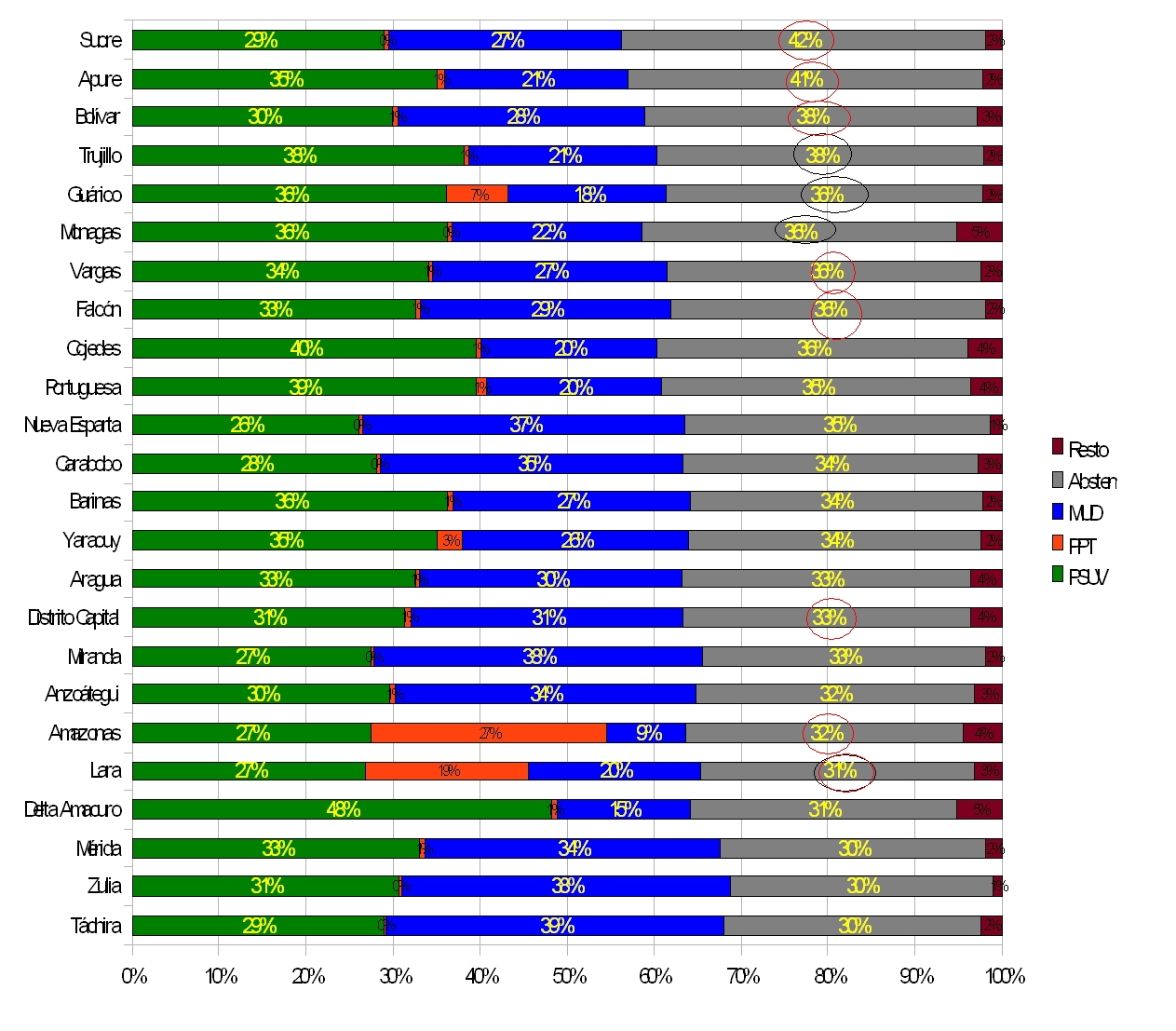
You can see here the list votes per state for 2010 elections, according to the Consejo Nacional Electoral. In the first chart you see total votes. Notice how the alternative forces clearly won in the most populated states. That is why the CNE had decided to do a little bit more of gerrymandering in those regions.


And look now at the second chart. Here you have the voting as percentage. You can see very clearly how abstention is the main "force" in many states. Abstention is clearly higher in almost every poorer district. There are many factors at play here: people are repelled by local caudillos that no one there really wanted, people there often think there is no hope whatever they do or they simply care less. Still, one that is often overseen by the top leaders of the alternative parties is that most people in those regions have no transportation means...unless it is a PDVSA bus mobilizing to vote for the military regime.

As I said in earlier posts, the opposition cannot just wait and wish people in those areas don't vote for the PSUV. The alternative forces have to go to those areas. Very unfortunately, some "national" party leaders are actually regional feudal lords (Táchira's governor, Carabobo's governor) and none seems to want to move his or her ass unless he/she is declared the national candidate. As usual in Venezuela, everybody wants to be the absolute leader and almost no one wants to do the hard work that is needed. Alternative forces do not seem to be studying the country's demographics. Most people do indeed live in cities, but "cities" does not mean Caracas, Maracaibo and Northern Valencia.

It is true alternative forces have very little financial resources and it is true Chávez thugs organise mobbing actions everywhere the alternative forces try to spread their message. Still, there is no way around this: the alternative forces must start now to set up networks everywhere in Venezuela. They need to do that on a clever basis. Parties need to merge when needed. They need to send not just "the annointed one", but teams with a common message and a programme. Journalists also have to start asking hard questions to the alternative "leaders". What is the reason for COPEI, Proyecto Venezuela and Convergencia, among other parties, to exist at the same time? What's the different apart from their caudillos? What are the ideological or programmatic differences between AD, UNT, Voluntad Popular and others?

Venezuela is no longer a democracy. It is an autocracy in a very similar way as Russia now. Leaders need to grow up. Most importantly, national teams with a clear message of pluralism and plans for sustainable development need to take hold.

Saturday, 26 February 2011

Venezolanische Geschichte für Dummies (II)

I - II

Es ist wichtig, die geographischen Merkmale des Landes zu kennen, um die Entwicklung der Region seit Jahrtausenden zu verstehen. Ganz allgemein kann man folgende Gebiete unterscheiden:

  • Anden und Küstengebiet
Das Küstengebiet ist an sich sehr vielfältig. Im Westen -zB Guajira- und Corohalbinseln- ist das Klima oft sehr trocken. Im Zentrum und im Westen  befindet sich der Küstengebirgszug, eine Fortsetzung der Anden. Die Vegetation ist tropisch bzw subtropisch und die Pflanzenvielfalt riesig. Einige Küstengebiete waren ursprunglich  dichte Mangroven, die für menschliche Siedlung eine Herausforderung bildeten. Dazu gehören mehrere Regionen zwischen Puerto Cabello und Cupira, sowie das Orinoco-Delta. Andere Regionen bildeten vor allem Dschungel oder Wälder subtropischer Art.  Die Anden im Westen Venezuelas zeichnen sich durch verschiedene Klimazonen je nach Höhe. 
Ganz grob gesagt: die Anden und der Küstengebirgszug waren gut für die Entwicklung der Landwirtschaft. Allerdings hatte diese Region kaum Tiere, die gezüchtet werden und definitiv keine, die als Tragtiere fungieren konnten. Die Region ist aber so fruchtbar, dass früher Uramerikaner nur ein kleines Stück Land anpflanzen mussten, um genügend essen zu haben.


Diese Region wurde sehr gut von Humboldt beschrieben. Hier gibt es zwei sehr deutliche Jahreszeiten: eine Trockenzeit, die sehr lange dauert, und eine Regenzeit, die noch regnerischer ist als die der argentinischen Pampas. Die Llanos waren während des Tertiärs von Wasser bedeckt. Als das Wasser zurückging, blieb eine riesige Ebene, die sich von den Anden und vom nördlichen Gebirgszug bis zum Orinoco erstreckte. Unzählige Flüsse überqueren diese Region. Sie fliessen meistens vom Norden und Nordwesten zum Süden, zum Orinoco. Diese Flüsse werden zu richtigen Seen, wenn die Regenzeit kommt. Im Gegensatz zum Nilgebiet sind riesige Areale der Llanos überflutet. Während der Trockenzeit ist alles sehr trocken. Viele Tiere müssen im Schlamm kriechen, um etwas Wasser und Schutz gegen die Sonne zu finden. Der Boden ist extrem sauer und hat weniger Nährstoffe als andere Regionen. Ohne Bewässerungsanlage kann man während der Trockenzeit kaum etwas unternehmen.

Es war extrem unwahrscheinlich, dass Menschen in einer solchen Region jemals Landwirtschaft von sich selbst entwickeln würden. Es ist kein Wunder, dass die Uramerikaner, die bei Ankunft der Europäer da lebten, immer noch vorwiegend Jäger und Sammler waren, im Gegensatz zu denen, die in Bergen und Küstenregionen ohne Mangroven lebten. 

Es ist sehr wichtig, diese Region zu verstehen. Während man in Mexiko und Peru, aber auch in Teilen Kolumbiens grosse Regionen im Zentrum hatte, wo man leicht Landwirtschaft, selbst ohne Bewässerungsanlagen, betrieben konnte, war das in Venezuelas Mittel nicht der Fall. Als die Spanier in Mexiko ankamen, fanden sie grosse Siedlungsgebiete im Zentrum. In Venezuela waren nur die Regionen in der Nähe der Küste und in den Anden dicht besiedelt. Vor allem im Westen und im Zentrum der venezolanischen Llanos - wo Otomaken und Guamos lebten- führten die Bewohner ein karges Leben als Sammler und Jäger, die vor allem in der Regenzeit genug zu essen hatten.

  • Guayana und Amazonas
Diese Region, südlich vom Orinoco, ist extrem fruchtbar. Allerdings sind die Urwälder oft so dicht, dass die Besiedlung keine leichte Aufgabe war. Dazu ist die Bodenschicht mit Nährunstoffen sehr dünn.

Was wissen wir über die ersten Einwohner Venezuelas?

Friday, 25 February 2011

How to make a nation of beggars


Black beans, pinto beans, red beans, green beans: they all grow so easily we used to take them for granted in Venezuela before Chávez came to power. You could do nothing wrong if you were growing beans in Venezuela's fertile land. Now we are importing them from China. We are also importing cereals and vegetables from there. The military regime says it is making Venezuela more secure because it will store some of those imports.

This is absolutely mental. Venezuela importing beans from China is like Spain importing olives from Vietnam

Update: well, actually it is not: you need to wait years and years before your olive tree produces the first olives and olivie trees require particular soils and seasonal temperatures. You just have to wait weeks to see the beans grow and they grow very easily almost everywhere in Venezuela.

The military regime is also letting the Chinese and some Belorussians do the construction work in Venezuela. Why? Because now Venezuelans are incapable of doing that themselves. Productivity is lower than ever.

Weight-ligting and gun-tottering Juan Carlos Loyo, the minister for the "Popular Power for Agriculture and Land" said Venezuela imports no more than 30% of its food requirements. And cows lay eggs. He says Venezuela will now "export bananas". In reality the Chávez regime signed a deal in Russia early last year that would benefit Russian corporation JFC at the cost of Venezuela's private producers. Once Chávez came back to Venezuela, he expropiated the land Russians had an eye on already. So far for food independence. I wrote about that case in Spanish here.

Ecuador of all countries is exporting vehicles to Venezuela now. It used to be the other way around: Venezuela would import some parts, produce some others and assemble them for internal production and for export to some countries in the region. That was before Chávez came to power. The Veniran join venture between Iran and Venezuela to produce vehicles is one of the many forgotten stories of Chavismo.

The regime can still do all this because oil prices are at record levels. Only for some months in 2008 were they higher. And yet Venezuela's total debt in 2009 was 36.35% of its GDP when it was 32% in 2000. As a reference: the OPEC basket price was  $27.6 a barrel in 2000 and $61.01 in 2009. This year the OPEC barrel is giving on average $95.85.

If you read Spanish, check out El País's article for further details on how the regime is wasting the biggest oil boom in Venezuela's history.

Many have predicted the fall for years now but no one ever thought oil prices would keep rising this way. Still, once thing is sure: oil prices cannot keep increasing forever and Chavismo can get less and less for each petrodollar it receives. When the fall comes, it will be disastrous.

If you think the percentage of beggars is staggering in the US, wait until you see Venezuela now

Von Militär zu Militär: Wie die Chávez-Regierung Gaddafi unterstützt

Hahaha, ich scheisse auf Menschenrechte in Ländern, deren Regierungen mein Kommandant-Präsident verteidigt

Aussenminister Nicolas Maduro musste gestern vor der Nationalversammlung reden. Das ist die einzige Möglichkeit der alternativen Parteien, Minister zu befragen -Chávez ist davon ausgeschlossen-.

Die Opposition fragte, wie die Chávez-Regierung ihre Beziehungen zu Gaddafi erklären konnte. Gaddafis Freundschaft zu Chávez ist genauso bekannt wie die Berlusconis. Gaddafi hatte zB vor kurzem die höchste Auszeichnung Venezuelas von Chávez bekommen und Chávez hatte erklärt, Qaddafi sei Libyens Bolívar.

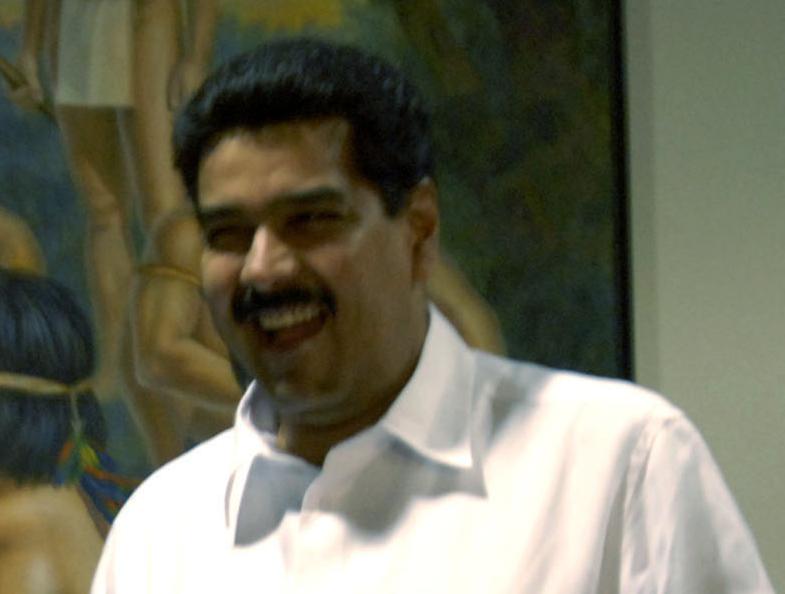
Maduro sagte nun, Al Qaeda-Gruppen seien für das Chaos verantwortlich und Libyen werde  von einem Bürgerkrieg bedroht. Maduro erklärte ferner, die Nachrichtenagenturen "des Imperiums" würden nur mit Vorurteilen informieren. Der  Aussenminister verglich die Berichterstattung der internationalen Medien jetzt mit der Berichterstattung während der 11.4.2002-Demos und des darauffolgenden Coups in Venezuela. Und dann fragte er, warum die Opposition nicht untersucht, wer Irak, Afganistan und Pakistan bombardiert, als ob das mit Venezuela zu tun hätte.

Chávez oder derjenige, der sein Twitter-Konto verwaltet, twitterte währenddessen folgendes:
"So ist das, Kanzler Nicolás, erteil den ultrarechten Yanki-Knechten noch mal eine Lektion. Es lebe Libyen und seine Unabhängigkeit. Gaddafi konfrontiert einen Bürgerkrieg"

Vamos Canciller Nicolás: dales otra lección a esa ultraderecha pitiyanqui! Viva Libia y su Independencia! Kadafi enfrenta una guerra civil!!"

Ihr könnt Daniels Bericht auf Englisch hier lesen. Ich bin lediglich mit einer Sache nicht einverstanden: Gadaffi verachtet die Menschenrechte, er ist aber meines Wissens und laut Experten wie Scholl-Latour und Robert Fisk gar nicht Al-Qaeda-nah. Gaddafi erwähnte diese Terrorgruppe schon, um Angst bei den Europäern einzujagen -vergeblich. Die europäischen Regierung scheinen nur zwei Sachen im Kopf zu haben: den Flüchtlingsstromm zu verhindern und die Erdölgeschäfte so bald wie möglich zu normalisieren. Das ist aber eine andere Geschichte.

Eins ist klar: Chávez bereitet sich vor für die Zeit, wenn das venezolanische Volk massal protestiert...Volk, das seines Erachtens nicht das Volk ist, denn das Volk ist nur, wer hinter ihm steht.

So wie Gadaffi hat Chávez einheimische - die milicias bolivarianas - und ausländische Söldner - die Kubaner der Sicherheitseinheiten-. Im Gegensatz zu Libyen kann Chávez Venezuela nie ganz abschotten. Das Land war allzu sehr mit dem Rest der Welt verbunden, als er an die Macht kam - dies ist etwas, was viele Ausländer gar nicht verstehen-. Diese milicias werden auch nicht so brutal sein wie die in Libyen jetzt. Und dennoch kann man schon erahnen, wie Chávez sich vorbereitet, um seine Macht zu verteidigen.


Klick hier, um die letzten AI-Berichte über Libyen zu lesen
Amnesty ist wahrscheinlich Chávez zufolge eine Abteilung der CIA

Hier für Robert Fisks Artikel in Libyen

Hier für Al-Jazeeras Bericht über Venezuela und Libyen


Thursday, 24 February 2011

Venezuelan tongues (II)

Imagine you burnt a Library of Alexandria every so many months. Well: that is the kind of information we are losing with the disappearance of so many languages all over the world.

A language is not just an alternative to express the same things. A language is a very complex system people use to shape universal and unique ideas, ideas that in turn reshape the system. A language is a world in itself. Take a look at this riveting video from The Guardian:


Venezuela's main language by far is Spanish. That has been the case for probably 400 years now. Still, there are still many languages spoken by the First Nations. Most of them are under threat.

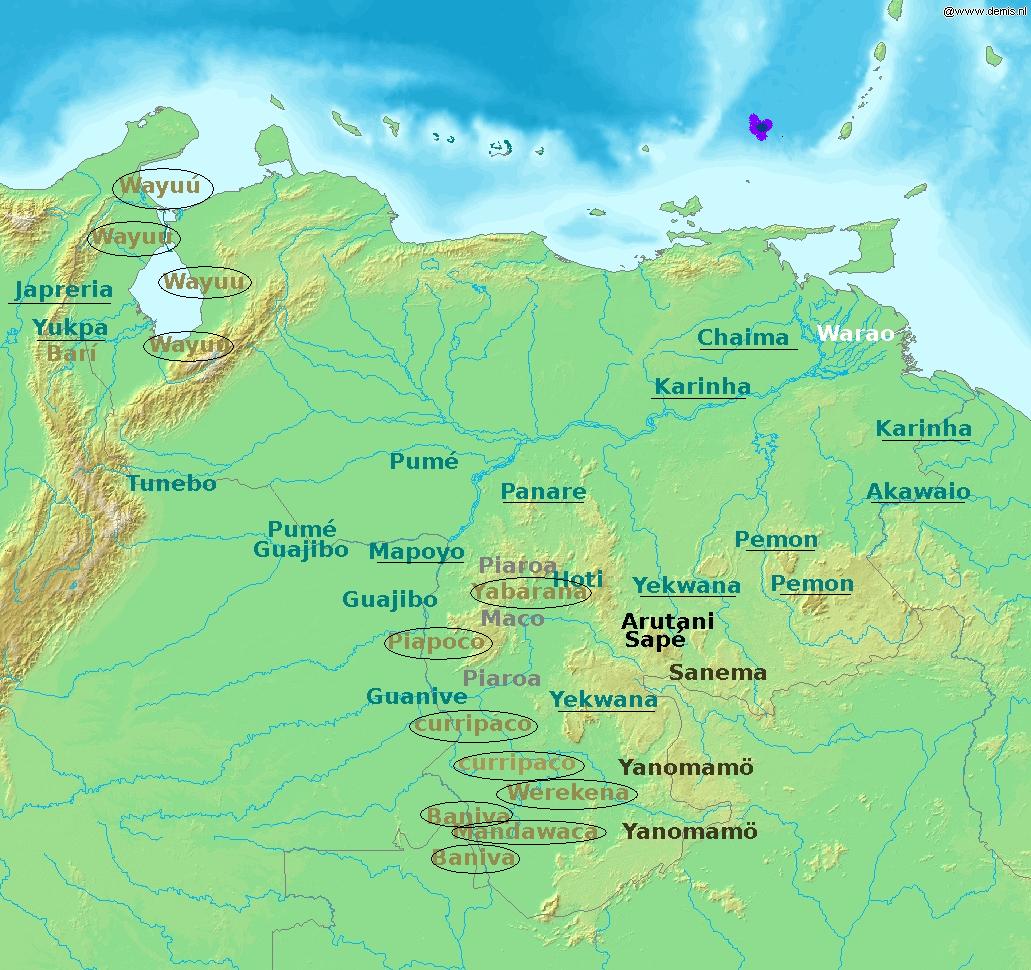
The present map shows the main native American languages still spoken today in Venezuela:


The main language families are the Arawak family (Wayuu and Warekena, Kurripako and Piapoko) and the Caribe family (like Pemon, Yekuana, Yukpa and Panare). Pemon and Yekuana are like Spanish and French or perhaps Spanish and Romanian. Pemon and Arawak languages are as far apart to each other as possible. And then there are several languages that stand alone. They are like Basque: there is nothing around like them. One of them is Warao and another is Uruak.

Warao is a language still spoken by about 20000 to 30000 people in the Delta. Uruak is a language that is probably extint or about to become extint at this very moment. There are several other languages that are on the verge of extinction in Venezuela. Uruak and Sapé are some of them.

Some two years ago the Venezuelan government finally approved the creation of the Instituto Nacional de Idiomas Indígenas. It exists on paper alone. The laws on promotion of the native American languages have been implemented only so far. We need more than just letting children sing the national anthem in a couple of those languages or to finance for just some time a couple of programmes for children to learn to write some lists of words in their parents' language.

If the government or private organisations wanted to spend just some dozens of thousands of dollars -less than what you need for a fancy jeep-, there would be enough to save one Library of Alexandria and a lot of our unique cultural wealth. We have several Libraries of Alexandria in Venezuela and they are burning right now.


Ps. I have written a bit on native languages in Venezuela in Wikipedia and you can read some of it from here

Libya, Venezuela and the rest

Venezuela's regime goes on supporting Chávez's friend Muammar Gaddafi. Chávez had previously declared Gaddafi was the Simón Bolívar of Libya and he gave him the highest prize there is in Venezuela, the Orden del Libertador. Now you can see how the Venezuelan news agency keeps only reporting Gaddafi's side plus wha Fidel Castro says and some handpicked news on the European-US American reactions. "Telesur reveals campaign of desinformation about Libya", "contradictions within the EU towards Libya" and so on.

You don't read anything about Gaddafi's crimes, about the massacres, about Gaddafi threatening to kill people if they do not surrender. It makes you wonder if Hugo Chávez will also try to use Cuban intelligence people. Cuban security thugs have been in Venezuela for many years now.

Europe

William Hague, Britain's Foreign Secretary, was clumsy at best when he prematurely declared Gaddafi was on his way to Venezuela. He probably wanted to use the impressions public had on Gaddafi to remind them of Chávez.

Again, Europe is proving to be unprepared to deal with this kind of crisis. We hear Cameron saying it is naive to want to prevent weapons export to dictatorships. I want him to explain that statement is naive and his not shameful for Britain.

German Thomas de Maizière seems to be more worried about refugees than about anything else.


Just some of the key places now

Red: places that seem to be liberated from Gaddafi's regime
Green: places were fighting is going on


Some of the sources:
The Guardian
Al Jazeera
Spiegel