Wednesday, 18 March 2009

Orinoco I


The first time Europeans saw continental America, after the failed Viking attempt at establishing a permanent colony in Vinland, was in 1498, when Columbus made his third trip. The first part of continental America he and his sailors saw would become one day Venezuela.

He firstly arrived to what is now the island of Trinidad. He turned from there to the Paria Peninsula and then to the Orinoco Delta. He described how surprised he was to discover the ocean waters were sweet many miles away from the coast. This showed how strong the river flow was. It also signaled that could not be just an island. Still, Columbus tried to cling to his preconceived idea he had arrived to Asia and blinded by his religious fundamentalism, he thought he probably was close to Paradise. Furthermore, he conjectured, looking at the horizon, that the Earth was not round as Ptolomeus said, but

"que es de la forma de una pera que sea toda muy redonda, salvo allí donde tiene el pezón, que allí tiene más alto, o como quien tiene una pelota muy redonda y en un lugar de ella fuese como una teta de mujer allí puesta"
"that is form is as a pearl but all round, but there where it has its nipple, which is at a higher point, or as a very round ball and in its place it were as the tit of a woman placed there"


So, he thought the Earth was like a pear or a woman's breast. Go figure. He also wrote about the Indians, who "son todos de muy linda estatura, altos de cuerpo y de muy lindos gestos" ("are of very nice height, high of body and of very beautiful features"). He noticed many had gold and pearl ornaments on their chests. Columbus wanted that gold and those pearls. He "asked them" (one only wonders how as it was their first encounter ever) where he could find more gold. He thought he understood it was behind a mountain to the West and that he should not go there as there were people who eat people there. He also asked them where they found the pearls and they also pointed to the West and North.

This would be a theme Europeans would kept observing time after time. They were after quick wealth, gold and silver and pearls.

The area where Columbus landed was in what now is the Sucre State, just to the west of the Orinoco Delta. He called the Paria Península "Island of Grace". If you read Columbus' writings particularly about this third trip you may be tempted to think he was crazy. He was just the product of his society, still immersed in ignorance and preconceived ideas plus plus a great desire to discover.

The Orinoco would start receiving more visits in the following years. The Spanish emperor, highly in debt with the South-German Felser and Fuger merchant families, gave them Venezuela as administrative region for a couple of decades. Ambrosius Ehinger and his successors explored the Orinoco all the time in search of El Dorado. In 1531 Diego de Ordaz sailed from the main outlet of the delta up the river to the Meta. In 1545 Walter Raleigh,also explored the river in search of easy treasures. Several other expeditions by filibusteers followed.It was only in 1800 when Alexander von Humboldt explored the basin on a non-predatory basis. There he reported about the pink river dolphins and he went with Bonpland on a remarkable quest to find the connection between the Orinoco and the Amazon rivers, a connection native Americans very well knew.

Let's try to explore a little bit the Orinoco. It is a long way: 2,140 kilometers. It has an average discharge of 33,000 m3/s and its basin has a surface of about 880,000 km2.

We will start by visiting the Delta Amacuro state.


A couple of interesting historical books about the European "discovery" of the Americas from the XV century onwards:

Crónica de Indias

Urs Bitterli, Die Entdeckung Amerikas
TzvetanTodorov, La Conquête de l'Amérique

Monday, 16 March 2009

Chavez's march towards...


absolute control has picked up steam.

Most people abroad are already aware Venezuela is heading towards less and less democracy and yet they are not aware of how serious the situation is becoming. Let's put some perspective.

We got local elections last year and even though Chavez's party took away most states and municipalities, the opposition managed to win states or municipalities where 45% of the population lives. Some of the largest slums in Venezuela (and Latin America) like Petare, actually voted mostly against the pro-Chavez candidate.

What has happened? Well, apart from the fact Chávez pushed for a referendum to lift up the term limits (this in a very strong presidential system), something for he had the government spend 12 billion dollars in "social programmes" (actually giving away free food and similar things and nothing about sustainable development), he has increased the speed in which he is taking away the few powers the opposition had. Among other things,

  1. The local governments where Chavismo lost made important money transfer to the central government just before stepping over, leaving the incoming mayors or governors with much less money than expected
  2. The pro-Chávez mayor of Maracaibo transferred on the last minute the control of Maracaibo's underground to the central government
  3. The national government issued a decreed to transfer public hospitals from Miranda state to itself
  4. The national government took over the local TV channel Ávila, which was under the control of the Caracas mayor (now opposition)

Now the central government declared it was taking over harbors, airports and motorways of Zulia and Carabobo, where the opposition has been trying to "govern". Those harbors, airports and motorways used to bring most of the money for those states. Both governors have declared they would oppose the take over and Chávez has threatened to take them to prison.

And some people abroad were saying the gains the opposition got in the last elections were a chance to prove how they could govern.


Wednesday, 11 March 2009

Is Venezuela entering a new Ice Age?


El Universal reports today (Spanish) "an intense cold wave hits the North-coastal region" of Venezuela: temperatures drop to a minimum of 16°C to 17°C and max of 29°C to 30°C.

Venezuela's non-mountainous regions are usually very warm, but the fact people now react so surprised at this "cold wave" shows how they have become used to ever-rising temperatures in the last couple of decades. A local minimum of 16°C is a shock. Unfortunately, hardly anyone records temperatures over a long period of time in Venezuela so that the population can be reminded this used to happen at this time of the year. There is a weather service, but it seems journalists don't check out with them now about the long-term conditions. Our coastal region is at a latitude of 10° in the Northern hemisphere, so we are sort of getting out of winter.

Sunday, 1 March 2009

The worst it gets, the more Mugabe Chavez will become

Mugabe? What kind of exaggeration is that?
Well, things are still far from the Zimbabwe level, but it has only been because Chávez so far did not need to. With an oil boom as we had not seen for decades, he could spend immense amounts of money buying up people, even if he does not invest in Venezuela's sustainable development and even if the murder rate has more than tripled since he is in power and a lot of other things are not working as they should.

But now, with oil prices "only" 200% what they were when Chavez came to power in 1998 and only half what they were last year, Chávez will have to look for scapegoats. Bush is gone and even if Obama will become the new ogre, that won't be enough. Venezuela has price controls of every kind plus a stupidly overvalued currency, a disastrous economic management and more corruption than ever (which is to say a lot). In view of that, the country has the highest inflation rate of the continent and companies do not want to invest. Now, it is getting very difficult to national companies to survive in this framework. Things start to disappear from the supermarket shelves: from rice to toilet paper, you never know when you will see them again. That has happened time on and off in the last couple of years and now the situation is worsening again.

So Chávez decided to take over the rice factories.

Here in English
Here in Dutch
Here in German
Here in Russian
Here in French (most likely invalid link after today)

I forecast the following:
  • the government will keep up confiscating more companies this year
  • at the same time it will look for deals with foreign investors that can give them fast cash now, even if the deals are compromising Venezuela's future (think deals on oil, gold, wood, etc with the Chinese, Russians, French, even US American companies, in spite of all the anti-US talk). As investors know by now how risky Venezuela is getting, Venezuela's government wil have to pay an ever higher price
  • the government will start to promote, as it did some years earlier, squatting big time: there have been lots of squatters since 1999, a lot of them have even become professional squatters (getting one piece of land, reselling it, going to the next), but the amounts of people occupying buildings or lands have always increased when oil prices haven't risen fast enough or when they stagnated a bit, as in 2002)
  • the government will illegally slow down - again - the flow of tax money to areas where the opposition won in the last local elections and will use money in distributing goodies there to buy up new voters

That is still not a Zimbabwe level, at least not economically. We simply have too much oil still (even if it won't ever be enough to cover up all needs of 28 million people)

It is often difficult to explain Venezuela's political mess to Northerners as that they tend to think in absolute terms. They think conditions tend to be either like in Western Europe, with relatively free press, with real debates between government and opposition or like in a Lukashenko-like regime where no public dissent is tolerated. OK, they also suspect there are lots of countries where there is some form of democracy even if there are lots of human rights violations, like in Mexico. Still, when they hear the opposition cry we are heading into a dictatorship they rightly try to look for signs of a Lukashenko situation in Venezuela. They won't find it yet, even if they do report of a personality cult as seen only in Turkmenistan with their late dictator.

Venezuela is a wee bit different. We had a dysfunctional but real democracy for many decades now. We used to speak loud. There were lots of human right abuses, but still we had a democracy and we could speak out our minds. We still do after 10 years of Chavez in power, as long as we do not work as state employees. But things have been getting more difficult for years since 2002. Right now we have a dialogue of the deaf and the government is trying to make every possible open debate impossible. It still leaves a lot of apparent freedom of speech for some TV channels. It uses them as Potemkin villages...as long as they broadcast to a group of converted anti-Chavez supporters, everything is fine. That is how in Venezuela you have Globovisión, a TV channel you can only watch in open airwaves in Caracas and in places where people have cable or satellite dish. There you can hear Chavez is a dictator, that he is taking Venezuela to a path of communism and much more. The problem is that that channel and RCTV (similar stance, less political programmes) can only be seen by 30% of the Venezuelan population. Then you have a lot of private channels that have decided since 2002 to stay away from politics. They show a lot of sports and soap operas and the like. Finally you have on the other side the Chavez channels, which are just a Chavez propaganda machinery and where you hear the opposition are just a minuscule group of CIA-supported olygarchs who are planning a coup (as if Chavez had not been our first coupster in many decades). There are also the cadenas, which are government messages every radio or TV station in Venezuela has to broadcast live. The cadenas were used once or twice a year for a couple of minutes during previous governments, but now with Chavez we have several hours of cadenas a week. If you are on your car in Venezuela you better have some CDs with you.

Venezuelans read very little even if literacy for many decades have been over 90%. Those who do read can buy El Universal and El Nacional, which are relatively good newspapers critical of Chavez where many Chavez supporters also write (and praise Chávez). They can also read Tal Cual, a magazine mostly bought by the political junkies who oppose Chávez. Tal Cual's main editor is Teodoro Petkoff, a former guerrilla and current social democrat. Apart from that, there are the pro-government newspapers. There you would never have a person critical of Chávez talking, unlike in Globovisión, El Universal or El Nacional.

So, we are far far away from Zimbabwe, both politically and economically. Still, we will be getting closer to it every day.

Thursday, 26 February 2009

The taste of a piranha and other things


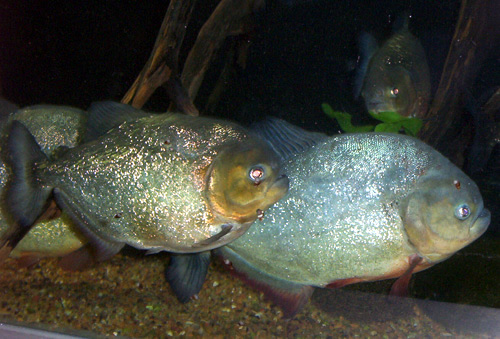
I miss that. Since I am right now in Europe, I haven't eaten piranhas for a while. They really taste good. Salmon? No comparison. I'd rather eat a piranha time after time. I remember once I helped a little bit at an exhibition organized by Latin Americans at the University of Glasgow. The exhibition, set up next to the university's library, contained objects Latin American students and professors had put together. All in all, it made for an interesting show: there were traditional clothes from the different Latin American countries, music instruments, pictures, ceramics. I showed the place to a group of school children. I remember when I came up to a stuffed piranha one of us had brought. The children looked at it in amazement, specially at its teeth. I told them piranhas live in the Amazon and the Orinoco basin, I told them there were many species of piranhas, I told them about piranhas' habits and at the end I said with feigned off-handedness: "oh, and they are delicious". The children found that specially cool.

So, yes, we eat piranhas. You can buy them even in the supermarket in big cities. They can be dangerous to humans under certain conditions, but it is generally we who are more dangerous to them. Piranhas have been food for the native South Americans for many thousands of years. They are one of the many wonderful creatures you can find in the Orinoco basin.

I haven't heard for months about the environmental conditions we have in the Orinoco basin now. I doubt they have improved, though. The latest I read about developments there last year was that the oil industry was polluting more and more. I also read about the transformation of Indian villages and the effect in the environment in the Orinoco Delta. I heard about problems with the pink dolphin. I have heard about the continuous problem of pollution generated by cities such as Ciudad Guayana. I know very well about the destruction the so-called "eco-turismo" is doing in Venezuela in general.

I want to take a look at the Orinoco in the following months, first from afar and them back there. If you happen to have some first-account report about the Orinoco, its environment, the effects on fish and other animals there, on its flora, send me an email, please.

It would be great if our grandchildren can know what a piranha tastes like, if they can see a pink dolphin swiming around there or the now critically-endangered Orinoco crocodile. Actually, as much as I miss the taste of a piranha, I can give it up for a big while in order to make its existance sustainable.


Ps. In the Wikipedia article on the piranha there is an interesting story about Teddy Roosevelt declaring piranhas "evil" for eating up a cow, the whole thing having been set up by people wanting to impress the president. This evil-calling from a pot rings a bell to me.

Monday, 23 February 2009

Just history


Howard Zinn is a well known US American historian. I don't share his views on some parts of history but I do agree with his general approach and most of his views. Here you have an interesting speech of his.

Now the Chavez National Assembly also wants to rewrite history...once again (link in Spanish). They will try to see who else they can discover as "anti-imperialist fighter". I have no problem with that as long as they call thieves thieves and the bandits bandits, whatever the political creed. I wonder if they would be interested in inviting people who do not consider themselves pro-Chavez to a live debate. I wonder if they would welcome an open discussion with lots of professional historians.

Saturday, 14 February 2009

Eurodeputy thrown out of Venezuela

On Friday the president of the National Electoral Council, Tibisay Lucena, decided to expel Spanish eurodeputy Luis Herrero. He had been invited by the opposition to be an observer together with three other eurodeputies and had been waiting in Caracas for the Venezuelan government to give him the necessary credentials. He decided to talk to the only opposition TV channel that has some reach, Globovisión. That channel can reach around 30% of the Venezuelan population, those who have cable or satellite dish or live in Caracas (otherwise people can only watch non-critical or extremely pro-Chavez TV). He talked too much, in my opinion. The National Electoral Council had declared it was going to extend the voting until 6pm, among other things. He said that was strange and he asked whether there was something behind that. Indeed, that is an issue in Venezuela. Tomorrow the sun will set at 6:06pm and then it will be pitched-dark. Venezuelans try all they can to go home before that time as it becomes too dangerous (Mexico ain't nothing compared to Venezuela and most areas were we have less observers are in the most dangerous slums).

Even if Herrero was clumsy in stating as a non-Venezuelan what we all know, the Venezuelan government did not respect any procedures: they just sent their "intelligence" force to grab him and took him to the first airplane, without allowing him even to take his passport or personal belongings with him.

Do you know what European politicians the Venezuelan government likes to invite?
People like former Belgian senator Jacinta de Roeck, who was an "observer" for the CNE in 2006. Among other things, she wrote in her own site the following (go to Infomappen and then Venezuela):

"Separate talks with the people in the street show that clearly. You have three types of Venezuelans:

* those who are 100% against him (usually the wealthiest). They have no good word to say about Chavez, the bosom friend of the great bogeyman Fidel Castro and - perhaps even worse - the friend of the poor people;
* those who are 100% for him (usually the poorest part of the population). Their position is often made intuitively, without criticism. They wear his picture on their shirts, they are cheerful when they call his name. For them, Chavez is an idol, he is the man whowill improve their lives. And he does it already, they see that;
* And then there is the group of critical viewers: Chavez is the only alternative that can currently take Venezuela out of the social clift, but they have a lot of (very constructive) criticism, and they fear a Venezuela Cuba-style.

In the original, in Dutch:

"En dat deze president wind doet opwaaien is zeker. Losse gesprekken met de man in de straat tonen dat duidelijk aan. Je hebt drie soorten Venezolanen :
  • zij die 100% tegen zijn (doorgaans de meest gegoeden). Ze hebben geen goed woord over voor Chavez, de boezemvriend van de grote boeman Fidel Castro en - misschien nog erger - de vriend van de arme volksmens;
  • zij die 100% voor zijn (meestal het armste deel van de bevolking). Ook hun standpunt is vaak intuïtief gevormd, zonder kritische kanttekening. Ze dragen zijn foto op hun shirt, ze glunderen als ze zijn naam noemen. Voor hen is Chavez een idool, het is de man die het leven voor hen beter zal maken. En dat doet hij nu al, ze merken het;
  • en dan is er de groep kritische beschouwers: Chavez is het enige alternatief dat op dit ogenblik Venezuela uit het sociale slop kan halen, maar ze hebben wel erg veel (opbouwende) kritiek, en ook vrezen zij een Venezuela à la Cuba."


I am not in any of these three groups and I know most opposition are not in any of those three groups either. I believe Ms De Roeck has been very insulting. It is like saying every Fleming is a racist unless he votes for her. Actually, there are more people in Flanders who vote for an extreme right party (Vlaams Belang) than there are rich people in Venezuela who dislike the poor. Opposition can be upper-middle class, middle class or poor in Venezuela. Definitely the vast majority are not opposed to improving the lives of the poor.

But I reckon a person like Ms De Roeck is the kind of politician the CNE wants to have in Venezuela. I am curious about the political parties of the observers the regime invited this time. It would be the most leftiest from the social democrats or rather people from the communist parties of Europe (not that Chavismo is about socialism or communism) and not all of them.