Sometimes the Chavista regime can be more predictable than other times. For instance, when the United States of America announces one of the Chavista honchos will be prosecuted for serious crimes, the Venezuelan regime feels the need to promote the accused.
That is what happened in January 2012: USA announced Henry Rangel Silva, among other Chavista military strongmen, was involved in drug trafficking. Lo and behold: Chávez named him minister of Defence.
Another military, Gustavo González, was among those the States decided to sanction for their responsibility in human rights violantions during the 2014 protests. Maduro made him minister of Interior.
Now the USA, after a long investigation, declared Néstor Reverol was a drug dealer and Maduro announced Reverol will be the next minister of Interior. There is a certain modus operandi.
And while Maduro is giving awards to criminals, you can read a very good but extremely sad article Alexandra Ulmer wrote about how women in Venezuela now seek sterilization in order to avoid child-rearing.
Only the First Lady's cousins won't be able to become ministers in a US prison
Everyone I know across Venezuela tells me the same: they are having a lot of trouble trying to make ends meet. Chicken? Onions? Beans? Meat? Flour? Hard to find and incredibly expensive for someone who earns in Venezuela's currency. We have heard for years now about the shortages in medicine supplies but now we have reached levels unheard of. We are entering hyper-inflation mode and the regime keeps talking about "economic war". Other bloggers have written a lot about this even if Chávez initiated the destruction of Venezuela's already weak economic structure, Maduro has accelerated the process. Maduro has allowed the shameless kleptocrats to prevail over all other interest groups of Chavismo. Desperation is increasing by the day. Still, most Venezuelans in Venezuela find it hard to understand things are going to get worse. When you suffer an inflation of over 150%, you haven't got much time to grasp it will keep increasing. You just try to survive yet another week.
On Friday we read of a major detained at the Colombian-Venezuelan border trying to smuggle cocaine. He had about 503 kg of cocaine in his lorry. This is nothing new but this major, Juan José Sorja Ojeda, turns out to be a permanent assistant to Hugo Chávez's father. The Chávez Family treats Barinas, their home state, as their fiefdom and there they have their haciendas, a lot of relatives have high ranking state positions. This major was a sergeant with nurse training who suddenly became a major. That is quite a jump in the Venezuelan military system.
Here you can see a picture of him next to Walter Martínez, the "star of international news" at the national - Chavista - state channel Venezolana de Televisión.
Juan José was very active on Facebook and he was a very vocal supporter of Chavismo. The fact that he was caught while trafficking cocaine doesn't say anything about independence of powers but everything about lack of coordination among the different groups in power now. It also might show at least some of the low-key soldiers controlling our roads do mean business and want to do the right thing. The minister of defence, Vladimir Padrino, rushed to explain the guy was "no real military". The reasoning? "A coward, someone lacking dignity, honour, someone scorning his arms, cannot be a military". OK...so I suppose most Chavista militaries, once discovered by others in some crime, stopped being military.
Venezuelans are getting more and more isolated and neighbours do not seem to care. If you speak Spanish, you can read Krauze's article about that in El País.
Well, you know: Makled was a gangster who was a Chavista first but then he wanted to get into politics in Valencia, the city where he was most active. That displeased Chávez and even though Makled came fourth when running for mayor of Valencia, the regime initiated a process against him. He fled to Colombia, the US and Venezuela fought for his extradiction, Makled wanted to be extradited to the US but ended up in Venezuela. Recently his trial took place and the judge gave him 14 years.
The government was not amused. What did it do? There was a speed investigation process of the judge who saw Makled and he was just sent to the Helicoide, where criminals are detained before some speedy trials.
This is not my fight. I am just observing how gangsters fight each other.
This is about who controls the cocaine traffic through Venezuela.
Journalist and fellow blogger Setty tweeted about this Spiegel article on cocaine traffic and the Venezuelan military. I re-tweeted it to several opposition politicians who usually re-tweet stuff I send them - I don't send them just about anything - but this time there was no reaction. I don't want to speculate much but chances are few in Venezuela will dare to ruffle Chavista feathers by discussing about this open secret in public.
The article - in English - is about how an European pilot unwillingly got involved in a cocaine transport organised by the Venezuelan revolutionary soldiers at Arturo Michelena International Airport, in Valencia.
Our friend Alpha placed a link with the answers to several questions the foreign minister of the Netherlands had to answer with regards to the Carvajal affair. It seems one of the opposition deputies in the Netherlands did ask the two questions I posted earlier. There are three pdf documents here (in Dutch).
The Dutch are well-known for their role in Sebrenica. Here a picture of Dutchbat
Minister Frans Timmermans admits the Netherlands has declared Hugo Carvajal persona non grata but based on the article 23 paragraph IV of the Vienna Convention a government is not obliged to explain why it has declared someone persona non grata and it won't explain why in this case.
OK, Mr Timmermans, you don't want to tell us why you are declaring Hugo Carvajal persona non grata but we know why. We just wanted you to write to the world you won't explain it.
Now the Venezuelan opposition needs to spread the word in Venezuela: Hugo Carvajal has been declared persona non grata in the Netherlands and Venezuelans should investigate why exactly.
I will later comment on the rest but if you are impatient and you don't speak Dutch, you can simply copy and paste into a machine translation engine to get some approximation in English.
The documents don't really say much that is new. They just show the usual diplomatic wobbliness. One can read a little bit between the lines, that's it.
We Venezuelans should also ask the Netherlands how far it will go to collaborate with the current regime in Venezuela. From now on we will keep a much better eye on what the Netherlands is doing towards Venezuela. This regime won't last forever and the Netherlands should know what that means.
I just read the questions to the Dutch minister of Foreign Affairs and his answers about the Carvajal affair. You can read that here (in Dutch). I am no deputy and I am not a Dutch citizen. I am a Venezuelan and a EU citizen. Still, I hope some Dutch journalist or politicians will manage to get the information from the Dutch government.
Mijnheer de minister Frans Timmermans
Als Venezolaan zou ik zo vrij willen zijn om U dit willen vragen:
1. Welke nieuwe informatie had u om van het eerdere standpunt af te wijken, om hierna de immuniteit van Hugo Carvajal te erkennen? (uw antwoord op vraag 3 kan dit niet uitleggen)
2. Wat is nu de reden om Hugo Carvajal ¨persona non grata¨ te verklaren in het Koninkrijk der Nederlanden?
Met grote belangstelling zie ik Uw antwoord tegemoet.
In English:
Dear Minister Frans Timmermans
As Venezuela I want to ask you the following:
1. Which new data did you have that compelled you to change the initial position and recognise Hugo Carvajal's immunity? (your anwer to question 3 doe not tackle this point)
2. What was the reason now to declare Hugo Carvajal "persona non grata" in the Kingdom of the Netherlands?
I look forward with interest to receiving your response.
This post will go with copy to the Dutch embassy in Venezuela, to the Ministry of Foreign Affairs, to De Telegraaf and to several opposition deputies of the Netherlands and Venezuela.
Hugo Carvajal is back in Venezuela. Why did the Dutch foreign minister Timmermans decide to release Carvajal on a Sunday night, very late in the Netherlands, when his functionaries and the judge in Aruba had said on Friday the detention was legit and Carvajal did not have immunity? Why so soon in spite of the request for extradition by NATO partner USA? Did Carvajal have immunity even if he presented a false passport? Were the US over-reacting thinking that false passport would be enough to get Carvajal or was it fair to consider the Dutch should have sent the man to the USA?
Timmermans
The Dutch newspaper De Telegraaf says that according to an officer in Oranestad (Aruba) the order to liberate the retired general came from the foreign minister Timmermans himself. So: the man in charge of the foreign relations for the Kingdom of the Netherlands took the decision to liberate a man who
came in with a false passport,
had over $20000 with him and had not declared that money
had not received the placet to become a consul,
was accused by the US of having tortured and murdered two Colombian officials, of having helped a terrorist organisation and being responsible for cocaine trafficking.
Why?
According to the Aruba officer Timmermans departed from the position of his functionaries based on "new information". Timmermans took the people in Aruba by surprise.
Venezuela's regime flew Carvajal directly to Caracas, where he was received by Maduro like a hero in front of masses of Chavistas gathering for the PSUV Congress. The state TV in Venezuela said "the Netherlands has recognised it violated the Vienna Convention".
The Venezuelan government hasn't said Netherlands has declared Carvajal persona non grata. He had to leave Aruba as soon as possible and that he will never be welcome in the Netherlands.
Some hypothesis:
The Netherlands only wanted to send a message that they didn't want a man with the history of Carvajal as consul. But: why the whole trouble?
Netherlands is afraid of what the mafiosi could do in the ABC islands
Any other hypothesis?
If you read Dutch, Alpha has collected some general information about this case.
In January 2014 one of the best known Dutch newspapers, De Telegraaf, published an article about the retired general Hugo Carvajal. A few of the issues it stated were:
Aruba is worried about the nomination of Carvajal, a general suspected of being involved in drug dealings as Venezuelan consul
Carvajal has been linked to the torture and killing of two Colombian military men
The US had him in the Clinton list since 2008 in relation to drug trafficking and the FARC
The Aruban Parliament had been discussing this back then. Opposition deputy Evelyn Wever-Croes from the MEP party had demanded from the Aruban government an explanation. The government responded it was up to Den Haag to decide whether to accept or not the man as a consul.
Maduro had signed that nomination 16 January of 2014.
There are lots of Venezuelan "diplomats" in the Netherlands and in the ABC islands and it seems incredible none of them read that article. Why was Carvajal going to Aruba at this stage in a private airplane?
Hugo Carvajal was born in 1960. There are two versions about his birth place: Puerto La Cruz, Anzoátegui or Viejo Fresco, close to Maturín, in the Western Llanos (not far from where Diosdado Cabello was born). I believe the right location is the latter. His sister, Wilma Carvajal, is the mayor of the Cedeño municipality, close to Maturín. She won over Pedro Emilio Briceño. I mentioned Briceño's clan in another post about gangsters from the Maturín region. Nepotism was always an issue in Venezuela but we keep reaching new levels.
Back to Hugo Carvajal: he finished his military studies in 1981.
In February 1992 he took part in the bloody coup led by Hugo Chávez. Carvajal was called "the other Hugo" and he was in the same prison with the caudillo until president Rafael Caldera set them free in 1994.
He worked for the Venezuelan Military Intelligence (DIM) from 2002 and he became its head in 2004. In April 2002 he was in Russia for training when the coup against Chávez took place and he came right away from Moscow. He arrived in Caracas and, handling a machine gun, asked everyone he met in the state buildings who was against Chávez. He was one of the first who got into the Miraflores building. He became colonel and vice-head of the Military Intelligence. 2 years later, in 2004, he became the head of the institution. He remained there until 2011.
Carvajal was in charge with negotiating the liberation of Richard Boulton, who was kidnapped by the FARC.
In 2008 United States accused him of cooperating with the FARC. Chávez defended him.
In 2012 opposition deputy Ismael García wrote on his Twitter account someone told him Carvajal and a judge had left the country. This was false but: is there something about this?
24 April 2013 Maduro named him head of Military Counterintelligence, which is the new DIM. If you visit the site of that organisation you will see they don't even update the dates (2012 is the latest).
In 2014, when Maduro decided to send Carvajal to Aruba, he named general Iván Rafael Hernández Dala (born in 1966) the new head of the Military Counterintelligence. Hernández Dala had been colonel until mid 2013.
What game is being played here? What can Ismael García tell us now? Why did Maduro think it was a wise move to propose Carjaval as consul to Aruba? Or did he just sign something proposed by someone else? Who was that?
If this happens just for the power at a Venezuelan embassy, imagine what can happen for the position of president in a caudillismo-prone feudal Venezuela.
Now read what the Nairobi newspaper The Star wrote about the issue. It contains further details for a typical Venezuelan case: a bottle of Johny Walker and a fixer.
And meanwhile, the military president Chávez is telling opposition candidate Capriles - yet again - that he is a Nazi. In case you don't know: Capriles' maternal great-grandparents were murdered by Nazis and his grandmother hardly survived.
Still, German deputy Sahra Wagenknecht has repeatedly minimized Chavismo's anti-Semitic comments telling us Chávez's comments were taken "out of context". She considers herself an expert on the issue. I will return to that...also dealing with those "contexts".
I posted some time ago in German about the increase in cocaine finds by security forces in Venezuela. In 2009 those forces found 15 tonnes of cocaine. In 2010 they found about 24.53 tonnes. In 2011 they have found at least 18 tonnes:
In February Venezuelan and French authorities caught in international waters 3.6 tonnes going from Colombia to Honduras,
By june, a total of 10.3 tonnes had been confiscated
Just in one action Venezuelan authorities caught 6.7 tonnes of cocaine
We still have almost 6 months to go. Of course, that cocaine is just a fraction of whatever cocaine dealers were trying to smuggle through and out of Venezuela to North America's and Europe's markets. Those markets exist because US Americans and Europeans pay real money.
Here I am not with other bloggers: I also think high ranking officials in Venezuela are likely to be involved in the drug trade in Venezuela but I don't think they are the only high ranking people involved in that. Mexico is in complete disarray in the fight "on" drugs. That could not happen if the military there were so kosher. And the US and Europe are not helping at all to improve things while keeping up demand.
On top of that, you have things like the Gunwalker coming from the States. Please, watch this CBS video about how the US government provided thousands of high-power guns to the drug cartels.
I am sure this hasn't been the first time and it won't be the last one. There are many reasons for that.
Is Venezuela's government a disaster with regards to cocaine traffic? Yes, indeed. Is the picture more complex than that? Yes, it is.
At best, the current situation is a complete mess and a farce by all government bodies. At worse, it is a mess with a lot of people on every side pursueing very nasty targets.
Ich lese die Zeitung: 14.24 Tonnen Kokain sind im Jahr 2011 beschlagnahmt worden. Wenn man so weiter geht, werden es Ende dieses Jahr 42.72 Tonnen sein.
Ich tippe ganz kurz ein paar Wörter in einer Suchmachische und finde heraus, dass die venezolanische Polizei im Jahr 2010 63 Tonnen Drogen beschlagnahmt haben soll, wovon 38.41% Kokain waren. Das heisst: 24.5322 Tonnen Kokain wurden im Jahr 2010 gefunden und sichergestellt. 2009 hat die venezolanische Polizei ungefähr 15 Tonnen Kokain in Beschlag genommen.
Also:
2009: 15
2010: 24.53
2011: 42.72?
Kommt es Euch nicht seltsam vor? Ich frage mich, ob wir jemals die ganze Wahrheit über diesen Fall herausfinden werden.
Kokaingebrauch in Europa: so viele Menschen finanzieren die Kriminalität in meinem Land
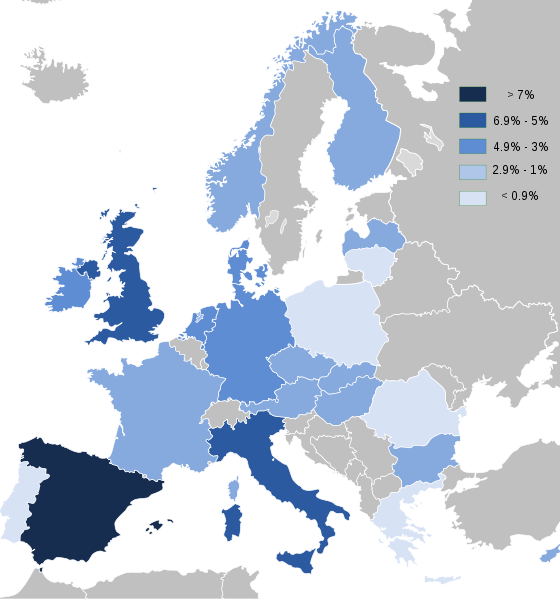
In this map you can see an approximate snapshot of cocaine use in the world some years earlier. The colours represent very approximate percentage of cocaine users within the total grownup population. The numbers are based on UNODC statistics. There are several regions with underestimates, I am sure, like Brazil and France and more and more Western Africa. As the percentage of children in such countries as Venezuela, Brazil and Argentina is higher than in, said, the US and Germany, chances are that the rate in those countries is a bit higher. Still, I think the tendency is more or less as the UNODC shows.
Every year over 50000 people get murdered in Latin America because of the drug wars. Countless get maimed and handicapped for life. Although consumption in Latin America is increasing and it is increasing fast, the main drug users and definitely the most important financing agents of drug dealers are "normal people" in North America, Spain, Britain, the rest of Western Europe plus Australia.
Who is benefiting from the current policy on the "war on drugs"?
drug dealers everywhere
military everywhere
private companies supplying personnel and all kind of gadgets for said "war on drugs"
some politicians
A future government of Venezuela will have to do its homework for fighting the cocaine trafficking and trade within and across Venezuelan borders, but it also needs to be courageous enough to tell the main consuming countries that they have as much if not more responsibility for the devastating cocaine trade.
Lots of vested interests around the world are against an open and thorough debate aimed at finding solutions to this problem. We need to create consciousness at every level and basically tell people everywhere that demand promotes offer.
On 16 September 2010 the Obama administration presents a report identifying what countries are cooperating what the US government calls the "war on drugs", something that has been a complete failure for decades now, as North consumers keep funding drug dealers. Venezuela is listed as one of the countries not cooperating, together with Colombia and Mexico, but the news agencies stress the Venezuela case.
On 16 September 2010 Venezuelan minister for Justice and Internal Affairs, El Aissami, announces the capture of INTERPOL-fugitive and drug dealer Beto Marín. There have been quite some captures of drug dealers in Venezuela this year and several of them have been deported to Mexico, the USA, the EU and Colombia. There had been some talk, specially supported by certain groups I mentioned in my previous post about an alleged Al-Qaeda-Venezuela connection through the cocaine trade. The cocaine comes from Colombia and it does not just go through Venezuela but through Mexico and not just through Africa to Europe but through many other channels.
On 16 September 2010 an article by Republican politician John R. Bolton appears about a possible Venezuelan involvement in weapons of mass destruction. You can read interesting stuff about Bolton's position(s) on WMD throughout the years. He was to a big extent responsible for derailing the biological conference in Geneva that wanted to enforce the 1972 Biological Weapons Convention. He did not want international inspectors to inspect suspected US weapons site. Bolton is a prominent figure of the Project for the New American Century. Mr Bolton is a commentator for Fox News and he is active for some think tanks like JINSA.
On 16 September 2010 Fox reports Venezuelan airline Conviasa declared it had just suspended flights between Iran-Syria and Venezuela. Fox says normal users could not buy tickets for that trip.
On 17 September 2010 the couple and former Alamo scientists Mascheroni is detained and indicted on charges that they passed weapons secrets to somone they believed to be helping the Venezuelan government but who turned out to be an FBI agent.
Now, the indictment does not come as a surprise. Very strangely this is not mentioned in the normal press. I had read about this Mascheroni case many months ago. The couple gave an interview at the end of 2009 after the FBI had raided their houses. Even the Mascheroni themselves said they had sold some nuclear-related information to someone they thought belonged to the Venezuelan government. The Argentine says he did not provide anything that was not available on the Internet and the prosecution says the couple provided secrets to an FBI agent thinking the agent was someone representing the Chávez government.
And on the same 17 September Conviasa declares it is suspending all national and international flights.
I have no idea. Do you see some patterns? Am I mixing up two different "issues" or not?
Francisco writes a post about the insinuations from former US ambassador Bolton that the Venezuelan government may be on the road to Latino nukes. I had seen the same kind of suggestions from US American sources for quite some time. As much as I dislike the corrupt military regime Venezuela has now, I have to say that in this case all this sounds like fabricating matrices de opinión, as zealous Chavista honcho Cilia Flores would say. Some groups have been particularly active in fueling this kind of discussion. Some US missionaries, for instance, formerly accused for many years of prospecting for uranium around La Esmeralda, started to throw the same accusations to Iranians in Venezuela. Are Iranians into that? I do not know and I think although we need to be cautious with Iran's activities in Venezuela, we need to be cautious with any accusations and who can benefit from them.
And now to drugs...
Some time ago I wrote about the Venezuelan plane that crashed in Mali loaded with cocaine. I asked some questions. I wrote again and again, based on what I read from Malian newspapers and some other sources. Because of those posts, a journalist working for a think tank based in Switzerland wrote to me with a form: please, answer in 4 to 5 sentences. Among other things, she asked whether I thought there was an Al Qaeda connection, as wrote Douglas Farah, a journalist son of missionaries who is apparently detecting Al Qaeda everywhere. I have to say I was shocked by how eagerly some draw conclusions on WMD and terrorists everywhere.
I had to say I frankly did not know, I could not get to those conclusions and what I could mostly see was that the Venezuelan military is deeply corrupt, more corrupt than ever, and that some people there may be involved in drug trafficking. This does not sell, but well, I am not a journalist. I wrote back stating I still don't see a case for accusing the Venezuelan government as such, as much as I dislike it, of having a policy to finance itself through drug trade or the like. There are other things that to my understanding are clearer, like the FARC/ELN connections (this from 5min and so much more).
Let's put it like this: I have the impression the Venezuelan regime is indeed very ineffective and there are military and police agents galore involved in the trade, but the Colombian government is not far off (yes, even considering the civil war going on there) and so is the Mexican one with its military and Mexico does not even have a civil war. Sure, cocaine trade through Venezuela has increased a lot in the last few years and this is very worrying, but Colombia is still the main land of production by far and Mexico is a mess because of the drugs, many of which are not coming from Venezuela. Who are the real actors in any of those governments? I do not know and I doubt very much many people know.
What I do think very strongly is that there are vested interests everywhere for the "war on drugs" to go on exactly as it has been going on for the last decades. Those vested interests include drug dealers, guerrillas, paramilitary, but also mid-ranking officers in the "security sector" in countries left and right, South and North.
Above all: the drug problem is hugely fueled by the dollars and the euros of North Americans and Europeans who don't see their consumption is in great part responsible for the many thousands of murders in Latin America every year.
Do we want a grown-up discussion about how to fight the drug problem? Or do we go on behaving in an irrational way and let ourselves be manipulated by different interest groups? I want one single journalist to ask an active head of state in the North the following: "could you tell us if you consider it would be political suicide for you to suggest the war on drugs has to be radically reconsidered?
Please, watch the following video and then the second part. It is about Mexico, but the rules and conditions affect everyone in America, from Canada to Chile...and also Europe, from Portugal to Russia.
I have mentioned it in some posts: those consuming cocaine in the North are right now responsible to a big extent for financing the very murderous drug bands in Latin America. Northern countries (or rich ones, as Australia is in this group as well) can accuse Latin American countries of not doing enough to curb the production and export of cocaine, but they are doing much less in curbing their consumption. The current international legislation on drugs, largely supported by the rich countries,is only good for drug dealers. One wonders if organisations insisting on keeping that legislation as it is (in Europe, in the US and at general level at the UNODC) are infiltrated. There is such a thing as the law of supply and demand, guys!
Many thousands of people in Latin America are paying with their lives every month caught in the middle of the cocaine wars financed with dollars and euros...money that ultimately comes from drug users.
Belgian Tom Boonen tested positive for cocaine 3 times
French Richard Gasquet took also cocaine "parce que c'est cool".
US Michael Irvin also took cocaine
and so are doing many millions of hijos de papá y mamá in the rich countries.
The Journal du Mali is reporting right now more news about the Boeing 727 that was crashed in Northern Mali after downloading up to 10 tonnes of cocaine and that would have come from Venezuela. As we know, United Nations and Interpol are investigating.
This is what they seem to know now:
the plane was coming from Venezuela (they don't say what further evidence they have, see below)
the drug was taken away in 5 4x4 vehicles
the vehicles may have taken the route to Niger
the plane was registered in Guinea-Bisseau
since last November Guinea-Bisseau had requested several West African countries to prohibit the entry of said plane as it was not respecting the flying routes
the plane had no more rights to fly from 31 October
the crew had decided to falsify papers as it could no longer fly like that and it had produced papers coming from Saudi Arabia
the transponder shows the flight started in Panama, went on to Colombia, the trace disappeared for several days (???????), then the plane popped up in Cape Verde, continued to Guinea-Bisseau and ended in Mali.
Several people from neighbouring countries seem to be involved in this issue and "heads may roll very soon"
the men trying to dismantle the plane were poor inhabitants of the region (something that reminded me of a scene in Lord of War)
Now I want to know why a transponder can show first something and then nothing and then something. I also want to know what further proofs they have about Venezuela.
The Venezuelan government keeps silence about the Venezuelan Boeing 727 that (was) crashed in Mali after it had downloaded a lot of cocaine. The German Deutsche Welle tells us the president of Mali, Amadou Toumani Touré finally talked about this incident. He talked on a state TV broadcast in the middle of the night as soon as he got back from a trip to Lybia and Qatar. He said he had not talked earlier because he did not want to hinder the investigations. Touré added the Mali government is collaborating with the neighbours and transmitted information to Interpol.
How long are we going to have to wait to know more details about that plane? From what airport in Venezuela did it set off? Stay tuned.
Two
Now, you may be wondering what Tibisay Lucena, the top woman of the Venezuelan Electoral commission has to do with Mali. I know one of my great-great-grandmothers came from somewhere in Western Africa, but what about Tibi? Was she on a kind of Roots trip?
Well, if you read French or use Google tools to read it, you can go to a site of the Malian governmenthereand read about Tibi's visit to Mali, Senegal and Guinea-Bisseau in April of this year. Or you just go and see the picture of Tibi, Venezuela's business representative in Mali and some Mali functionaries testing one of those machines. The visit was no secret in Venezuela. I read about it in a couple of Venezuelan newspapers and in pro-Hugo grassroot site Aporrea.
As the propaganda site Venezuelanalysis reported back then, the lady in red went to those countries "to share the experience that Venezuela has accumulated over the past ten years with our friends". She wanted to show basically how the Venezuelan voting machines work...or don't work. If you have followed this blog you may know the world's most modern voting system is much slower than manual systems and you may know the paper trail it produces often does not show what the voter actually wanted. Never mind, what is good for a Venezuelan is good for our friends in Africa as well.
From an earlier post you know Hugo has a very particular interest in those three countries in Africa.
Three
In July of 2009 the Guinea-Bisseau police seized a plane with 500 kl. of cocaine with a Venezuelan crew. There was a standoff as the Guinean military tried to stop the police from doing its work. That was not the first time and it won't be the last one. You can read a lot about Guinea-Bisseau's links to drugs trade in The Telegraph.
You can read a little bit about some cocaine seizures in Senegal here and here.
What am I saying? I haven't got a clue about what is going on but perhaps
the Venezuelan government should work openly with United Nations to clarify how the cocaine is going from colombia through Venezuela to those three countries.
those three countries should become more careful about using a voting system that is not reliable (think paper trail, think Germans and Dutch going back to manual voting, think Norway doing it like that all the time)
Now the Venezuelan government can say I am creating a "matriz de opinion". So be it. Just be more transparent.
A Boeing coming from Venezuela crashed last 5 of November in Gao, Mali, after it had downloaded cocaine in that area and tried to lift off (here in French, here less in Spanish). Interpol is investigating now.
How come? Where did the plane set off in Venezuela? Was it from Maiquetía, the main airport? Is it possible for the Veneezuelan military not to notice up to 10 tones of cocaine in a Boeing setting off for Africa? Did the plane depart from La Esmeralda, the huge military airfield in the middle of the jungle in Amazonas State? Or from somewhere else? From where then? That is a big big plane.
In any case, what the authorities found were the burnt rests of the plane. The drug dealers had set in flame and run away. Still, they found some rests.
I wonder if this has anything to do with the following:
The Venezuelan government has been increasing its ties with West African countries for some years. Here you can read (in French) an article in an official Mali site about Hugo's visit to Mali, about the visit of Mali's president to Venezuela, about how Hugo payed for over 100 social houses, a school and more in Mali, how he promised more and about how Hugo showed a big interest in the geography of Mali, on the Niger Riger and irrigation, about "mining interests" and deals of Venezuela in Mali and more (I will go back to that article later on and translate it).
All possibilities I see:
Some mid to high ranking military is using the new Mali-Venezuela links to trade in drugs behind the president's back
The top in the government is involved (I don't think so, too crazy)
Some drug dealers who have nothing to do with chavismo are involved and who just found a way to get around minor corrupt military in Venezuela
Someone is trying to pretend the Venezuelan government is involved in the whole thing
So far I go for 1. Too early to tell. It is an irony they found the plane close to Gao or "GAO"
United Nations Office on Drugs and Crime just published its yearly report on world drug. There is a lot of interesting and equally horrifying information in there. I just point to the issues relating to Venezuela.
Most cocaine is still produced in Colombia, although cocaine production can be found in Bolivia, Ecuador, Peru and Venezuela. Venezuelans used to say "Venezuela is a transit country, not a consumption, the problem lies in the producing areas and at the consumer side". It is true consumers of illegal drugs should be made responsible as well as they are financing a criminal and very lethal activity. Still, the Venezuelan public (not physicians and some other workers in the area of health) is deluding itself if it thinks the cocaine problem is not a big threat for Venezuela as well, in every sense. Cocaine consumption in Venezuela has been increasing for a long time already. You don't have many thousands of people working in the transport of cocaine and expect them to remain without addiction.
According to the UNODC, Venezuela accounted for the seizure of 32 metric tones in 2007. Colombia accounted for 60% of all seizures. The report confirms what we wrote earlier:
"Cocaine trafficked to North America typicall originates in Colombia and reaches the US through Mexico, either directly by speed boats or via cocuntries such as the Bolivarian Republic of Venezuela, Ecuador and Panama. Most of the cocaine (close to 70%) is estimated to be transported via the Eastern-Pacific route towards Mexio and some 20% via the Western Caribbean route."
Further, it says:
"The most frequently memntioned country of origin of the cocaine trafficked to Europe is Colombia (48% of countries reported Colombia as the source country for their seizures) followed by Peru (30%) and the Plurinational State of Bolivia (18% of the countries). The most frequently reported transit countries were the Bolivarian Republic of Venezuela and Ecuador".
Further it reads "the most important cocaine transit country [for Europe] in 2007 in volume terms was the Bolivarian Republic of Venezuela".
Very worryingly for Venezuelans is that whether cocaine consumption in the US decreased slightly and it stagnated in Europe, it has kept increasing in their land. The report lists Venezuela first in the list of South American countries where cocaine consumption has increased.
Venezuelans were the third largest group of foreigners detained for cocaine trafficking in Portugal in 2007. It is interesting to see Venezuelans follow with 10% of detentions the people of Cape Verde (with 52%), and those from Guineau-Bisseau (12%). Brazil, with a much larger population than Venezuela and speaking Portuguese, represented 8% of the foreigners caught trafficking cocaine in Portugal. So: Venezuelans are much more likely to be caught as cocaine traffiquers in Portugal than Brazilians. You could think that:
1- Venezuelans are more represented than Brazilians because they often don't speak Portuguese well and thus they don't find their way around as drug mules or
2- Venezuelans indeed have "issues": they are more likely to be involved with that traffic in Portugal than Brazilians.
Brazil has many more people, a higher purchasing power than Venezuela and the mother tongue is Portuguese and yet more Venezuelans than Brazilians get caught trafficking cocaine in Portugal. I haven't been able to find the statistics on Venezuelan versus Brazilian visitors to Portugal but I am sure more Brazilians visit Portugal than Venezuelans.
The report also talks about the increasing importance of West Africa as a transit route to Europe. The cocaine comes mostly from South America. As previously mentioned in this blog, Venezuela is one of the routes taken to ship the drugs to Africa. It goes through the Caribbean Islands or through the Orinoco Delta to the Atlantic Ocean and from there indirectly through Western Africa or directly to Europe.
A responsible Venezuelan government (hopefully we have a better one in 2013) should:
Recognize that even if Venezuelan cocaine consumption may not be particularly high, they are a big threat to the country and contribute to violent crimes
Enforce a policy of informing all foreign nationals that cocaine consumers are also guilty of cocaine-related crimes as they support a traffic that is illegal
Permanently bring forward to the international opinion the need to discuss how to tackle the drug problem: either you legalize the traffic and control it through hospitals and the like or you also follow a mature campaign in Europe and the US (and everywhere else) where everyone becomes aware cocaine consumers are financing drug cartels.
Cooperate fully with other countries in the drug control
Thanks to Bridge we got a Dutch article about the recent detentions in Curacao.
I won't translate the whole article. Just some highlights:
More than 250 police officers were involved in the action
The cocaine was in shipping containers to West Africa and Europe or in couriers going from Curacao or Aruba to the netherlands.
The organization was probably responsible for import and export of at least 2000 kilos of cocaine per year
The suspects were investing drug profits in real estate in Colombia, Venezuela, Lebanon, the Dominican Republic
The organization had contacts with Hezbolla in Lebanon; they were supporting Hezbollah
Lebanon uses the money to buy large amounts of arms from South America (where there exactly?)
Basically the route is from Colombia through Venezuela to Curacao/Africa/Europe
The ships went from Venezuela to West Africa and from there to the Netherlands, Lebanon and Spain.
Money couriers went from Curacao to Venezuela mainly
17 people were arrested. They were from Curacao, Venezuela, Colombia, Lebanon, Suriname and Cuba. There were 4 women and 13 men.
The police action was done in cooperation with the judiciary in the Netherlands, Belgium, Colombia, Venezuela and the US
My questions:
- was the judiciary in Venezuela really involved? - what route was taken from Colombia through Venezuela and what can Venezuelan authorities do about this? - would they really want to do something about it?