Showing posts with label health in Venezuela. Show all posts

Tuesday, 31 October 2017

Diphteria back in Venezuela


There is a rise if diphtheria cases now in Venezuela. The disease returned last year after 24 years gone. The country has an acute shortage of medicines. 

Some of my relatives in greater Valencia went yesterday to a vaccination centre but they could not get the vaccine: the centre ran out of material after treating 540 persons. My relatives  had still over 200 people in front of them and there were many more behind. The thing is: two people have died recently in Valencia from this disease, so there is fear. Chavistas would say it is all "capitalism's fault", Ceausescu style.

Early this year the health minister was sacked because she dared to do something health ministers had not done for some time under Chavismo: her ministry published the real numbers of child mortality and they showed what any decent physician or nurse or anyone related to health in Venezuela knew for a long time: things are getting worse.

Here you can see some WHO data from previous years about vaccination coverage in the world. Notice how the orange-yellowish circles indicating sub-optimal coverage start to pop up more frequently in Venezuela together with Haiti whereas things are mostly green in most other countries around, countries that were poorer before Chavismo arrived to Venezuela.

I wonder what Corbyn in Britain or Wagenknecht in Germany would say if journalists told them Venezuela is going through a health crisis it hadn't seen when the country had social democrats and Christian democrats in power, the democratic period preceding the election of military coupster Hugo Chavez. They would probably mumble something about economic war and, very clueless, about how things were worse before.


Wednesday, 31 May 2017

Children's foes


There is a new index about children's wellfare. Not surprisingly, Venezuela now offers children a worse standard of living than almost any other country in the Americas. Venezuelan children are now worse off than those in a lot of African countries.

That is very much unlike when I grew up in Venezuela's Caribbean.

This reports shows children are more likely to be murdered in Venezuela than in most American countries but for Honduras.

Venezuelan underaged girls are more likely to become pregnant than almost anywhere else, as I wrote already a couple of years ago.

Chavismo has to go away.

Saturday, 28 May 2016

Si eres hombre y quieres morir joven en Suramérica: Venezuela

Expectativa de vida en años desde 1990 en algunos países de Suramérica
Hay muchas conclusiones que se pueden sacar de analizar de manera correcta los datos de la Organización Mundial de la Salud relativos a la expectativa de vida en el mundo. Aun así, lo primero que me llamó la atención fue  el hecho de que actualmente Venezuela posee las segundas peores expectativas de vida de Sudamérica si uno es un hombre. Solo en Bolivia los hombres tienden a morir antes. El desarrollo de la expectativa de vida para las mujeres también se está rezagando, pero la situación es particularmente mala para los hombres venezolanos. La causa principal es evidente: violencia.

Aquí pueden ver cómo Paraguay y Colombia superaron a Venezuela en 2004 y 2008 respectivamente, en pleno período de Hugo Chávez. Eso fue algo que los tontos útiles que otrora aplaudieron al chavismo no percibieron.

Espero volver pronto con un post que ponga en perspectiva el desarrollo de la mujer en Venezuela en comparación con el resto de Suramérica.

Friday, 29 January 2016

The Zika virus in a failed state called Venezuela

I am just getting news from friend doctors about people who have caught the Zica virus in Venezuela.
Actually: one of my closest relatives got it already. I am deeply worried: the country is falling apart, it is ruled by a bunch of criminals and ideological wackos and medicine is in very scarce supply. Most people just feel sick, get rotten eyes, some fever and that is it. But then there is the microcephalia: apparently women in pregnancy who get that virus have a higher probability of having a baby suffering from this.

How the Zica virus was spreading in early January (Wikipedia)

Here Reuter's journalist Alexandra Ulmer presents a very clear picture of what is happening. For months physicians have been putting pressure on the regime to publish statistics about the spread of this virus. Finally Health minister Luisana Melo admitted 4700 potential cases of persons with the infection. Those of us who know Venezuela under Chavismo have learnt to interpret this as a fraction of a fraction of what might be true. 

Venezuelans lack repellents, paracetamol and many other basic products. My relatives and friends tell me about how hard it is even to buy garlic, milk, chicken and so much more.

Sunday, 21 December 2014

The spread of diseases in Venezuela of Maduro


Almost all of my relatives - we are talking about many dozens - are suffering from the effects of chikungunya. The same goes for neighbours and friends in several Venezuelan cities. We suspect one of our uncles died from it but we cannot be sure: the labs didn't have the required material to perform the necessary tests on his blood sample.

The sequels for almost everyone who gets chikungunya are tough. Once you get over the fever severe rheumatic-like pain keeps striking every so often for a couple of years. There are days when you cannot even hold a cup in your hands because your joints are so sore you can only twist your fingers in pain. The same pain appears in your legs, in your feet, in your hips. You cannot go to work.

The costs of this for a nation are enormous. The worst thing is that Venezuelans are having a hard time finding non-steroidal anti-inflammatory drugs like Paracetamol, the only ones that provide with some relief.


In Venezuela that is happening to a large amount of people and we hardly hear about them unless we know them. If you have families and friends who live in areas outside Caracas and the coldest regions of Mérida and Táchira, you know about this. If your news about Venezuela come from the newspapers, you will only see isolated and very vague reports here and there.


On 17 September 2014 the government reported 398 confirmed cases of chikungunya.
On 27 October 2014 the government admitted to about 7072 cases. Last November an opposition politician from Western Venezuela said the cases would be around 25556.

Alejandro Ríguez, epidemiologist of the Universidad Central de Venezuela and not precisely an amateur, declared on 11 December at least over one and a half million people are suffering from chikungunya in Venezuela and that figure, he said, would be extremely conservative. He based his estimates on reports from the Ministry of Health, reports that are now arriving later and patchier than ever.

The Venezuelan regime will probably say the already long-standing shortages of paracetamol and similar drugs are due to the "economic sanctions" the US government just introduced against a bunch of government honchos. That's how it goes.


Friday, 17 October 2014

Venezuela: wohin jetzt?

Der Erdölpreis sinkt weiter. Die Wirtschaftslage verschlechtert sich. Maduro sagt aber, Venezuela hätte genügend Resourcen und würde "weiter wachsen". Dies ist ein Zeichen dafür, dass er ein absoluter Idiot ist oder lediglich die Venezolaner für Vollidioten hält. Im Abbild oben sieht man die Entwicklung von BIP, Erdölpreis und Bevölkerung für Venezuela seit 1998, wobei "100" das Niveau jedes Parameters im Jahr 1998 repräsentiert. Was dieses Bild nicht zeigt: die Kaufkraft der Venezolaner ist jetzt geringer als vor 14 Jahren. Was ich mit dieser Graphik auch nicht zeige: die Wirtschaft wird dieses Jahr sehr wahrscheinlich um 4% schrumpfen und das in einem Land, dessen Bevölkerung um 2% wachsen wird.

Maduro erklärte, man habe das Haushalt für 2014 in der Annahme berechnet, ein Fass Erdöl würde 60 Dollar kosten. Es ist unglaublich, dass Maduro nicht erwähnte, wie viel mehr Geld die Regierung jedes Jahr ausgibt, als was sie im Etat geplant hatte. Viele Regierungen haben Haushaltsdefizite, dies wird aber öffentlich diskutiert und die entsprechenden Regierungen müssen erklären, wie es weiter geht. Nicht so in Venezuela.

Im Jahr 2013 hat die Regierung 61% mehr ausgegeben als vorgesehen. Dieses Jahr wird es viel mehr sein. Die Rechnung geht nicht durch: wenn der Erdölpreis weiterhin unter 110 Dollar pro Fass bleibt, wird die Wirtschaftskrise in Venezuela immer akuter werden.

Maduro sagte auch, dass er womöglich das Geld, das laut Verfassung an die Bundesstaaten fließen muss, anders benutzen wird und zwar wenn diese Bundesstaaten Gouveneure der Opposition haben, wie mit Capriles in Miranda. Vom Rechtsstaat haben wir keine Spur mehr.

Das Chikunguyafieber wütet im Lande. Die Regierung erklärte Anfang Oktober, man müsse die Krankheit "melden"...viel mehr als das hat sie nicht unternommen. Es gibt kaum Medikamente. Ich kann selbst berichten: fast alle meine Verwandten sind daran erkrankt und es ist für sie extrem schwer gewesen, medizinische Hilfsmittel zu bekommen.

Sunday, 21 September 2014

New Maduro strategy: physicians as terrorists


Ángel Sarmiento, head of the Physicians' Association in Aragua, a state not far from Caracas, declared on 12 September that 8 people had died in Maracay in the previous 72 hours of an unidentified disease. He said there were no facilities in Aragua to investigate what the cause of death was and that the physicians had sent the probes to Caracas but they hadn't got the results yet. He asked the government to speed up things. He asked international organisations to help.

Dr Sarmiento is very close to the opposition and he is befriended with Mardo. You just need to look at his Twitter account.
Maracay

The governor of Aragua, Tarek El Aissami, announced now there is an order of capture against Sarmiento for "terrorism". El Aissami said there is an investigation against the vice-president of the Medical Association as well. The vice-president had expressed support Sarmiento's statement. Just one day earlier the police had got into Sarmiento's house and visited that of his mother.

Let's remind peole who Tarek El Aissami is. He was born in Venezuela of Syrian parents. During his "studies" at the Universidad de los Andes he was mostly busy with organizing political activities and, some say, illegal businesses. His father apparently belonged to the Baath party in Iraq. His family is the typical group of socialist pan-Arabists who supported Saddam Hussein. The father was busy in extreme left actions for years in Venezuela. They have strong links to the Syrian regime. People of Syrian-Lebanese extraction are over-represented among the Chavista honchos.

Maduro had previously said the opposition is trying to carry out a "bacteriological war". He also said the regime-critical media was developing a psychological war. As you can see, for Maduro's brain, it's both: it's a lie that there are unknown bacteria or viruses killing people but if they exist, it's the opposition that is spreading them and, anyway, it's all fibs from the remaining government-critical newspapers.

Wednesday, 28 May 2014

Priorities of "socialist" Venezuela (corrected)


The Maduro government has approved 43 million bolívares - over 5 million euros* - to finance a soap opera that will portray Venezuela's war of Independence. Of course, we can expect the story to follow the usual myths the Venezuelan military and pseudo-historians have fed us with since that war ended.
No money for blood test but plenty of money for military soap opera crap

At the same time you will find out poor Venezuelan patients have to pay on average around €116 in stuff like blood tests and others in our "free" health system. When I was a child - before Chávez came to power - that was much less likely.

* OK, I stand corrected by 1000. It didn't make sense otherwise. Thanks to LemmyCaution.


Thursday, 15 May 2014

Low and great expectations for health in Latin America


I produced the chart above based on the latest data from the WHO. It shows life expectancy in 1992 and 2012. Back in 1990 Cuba was still the prima dona of Latin America. As you can see now, Colombia has caught up and Chile has clearly beaten Cuba.

Countries like Peru and Bolivia are doing well. Mexico is improving more slowly and yet it has caught up with Venezuela. Peru has caught with Venezuela and, as you could see from Colombia: it really beat Venezuela in spite of not having the oil Venezuela has.

The only country in this series that is converging with Venezuela - at least until 2012 - was Argentina.

Venezuela has squandered a lot of money. Yes, life expectancy has improved, like elsewhere in the region, but it hasn't improved as it should.


Thursday, 6 September 2012

Venezuela exportiert gute Ärzte


Eine gefährliche Entwicklung zeichnet sich in Venezuela: in den letzten fünf Jahren haben 12300 Ärzte aufgehört, für das öffentliche Gesundheitssystem zu arbeiten. Über die Hälfte von ihnen, 7000, sind ausgewandert. Wenn man bedenkt, dass Venezuela, wie Norwegen, den längsten Erdölboom der Geschichte erlebt, scheint die Sache paradox zu sein. Wenn man aber die Zustände der öffentlichen Krankenhäuser, die Politik von Spaltung und politisches Mobbing der Chávez-Regierung und die extrem hohe Mordrate des Landes berücksichtigt, sieht man ein, dass diese Entwicklung die logische Folge der Militärregierung Chávez ist.

Bye, Bye, Krankenhaus, ins Ausland

Ein Arzt mit 35 Jahren Erfahrung verdient ungefähr 6000 VEF im Monat, was offiziell € 1105  entspricht, auf dem Schwarzmarkt aber viel weniger ist. In Caracas oder Valencia kostet die Miete einer kleinen Wohnung mehr als in Berlin oder Köln.

Ich werde später mehr darüber berichten.


Wednesday, 6 June 2012

This year at a public hospital built in Venezuela over 45 years ago

I was born in this public - free - hospital several decades ago. It is still the only general public hospital in my city, Valencia. Valencia has over 1.3 million people. There are several private clinics, a couple of specialised hospitals and a series of tiny health centres  that are supposed to be one of the successes of the so-called "Bolivarian revolution". Foreign sycophants of Venezuela's caudillo praise those centres as "a great advancement". 

Venezuela now, thanks to external factors, is receiving several times the amount of petrodollars it used to get in the nineties - before Chávez came to power. Still, the "civic-military government" has let most hospitals - but for one or two Potemkin villages - crumble down.


Thursday, 1 March 2012

Hospitals in Venezuela

While Venezuela's caudillo is being treated in Cuba by doctors flown from different countries, patients at the CHET, the only general hospital in my city of 1.2 million people, have been since Sunday without running water. Their relatives have to take water bottle to the hospital to wash them. Of course, they also have to bring most of the medicine and medical material used on their loved ones, including syringes and gloves. That public hospital was built over 40 years ago. I was born there. Chávez's foreign enablers long wrote about the great advances in public health care in Venezuela - all rubbish.

In spite of Venezuela still going through the longest oil boom ever - thanks to China, India and the Peak Oil - the government hasn't built a single new general hospital in Valencia. There are a few tiny health centres plus a new maternity hospital built by the regional (non-Chavista) government. Most of the few hospitals built in the last 13 years are half empty, Potemkin villages in the "socialist revolution". If this is with a barrel of oil well over 100 dollars, I can't imagine what it would be if the military go on ruling the country for a few years more.

The oncology department of that hospital has been closed for some time as well.

Meanwhile, Russian, Chinese and Brazilian doctors treat the caudillo who tweets all the time the hash #viviremosyvenceremos, "we will live and win". The chuzpah.


Sunday, 30 October 2011

The mock doctors in Venezuela under Chávez

The president of the Academy of Medicine in Venezuela, Aoun Soulie, felt compelled to tell us for the nth time about a very worrying development: the education given to the so-called physicians of "Integral Medicine for Communities" is a farce.

This month 8300 people will get their title as "médicos integrales comunitarios" after having spent 6 years following an outdated study model based on Cuba's experience, which is based more on a myth than anything else. They spent all those years to become health experts and yet they have no training whatsoever in laboratory work, in tropical medicine (remember Cuba's not Venezuela), in radiology, biochemistry, parasitology, pharmacology, histology or anatomy (hard to believe but I got the same report from many good sources). They follow their courses by videoconference and have no training in the emergency rooms of public hospitals as was a must before Chávez came to power. Unlike physicians pre-Chávez, they have never been to operating theatres. Until now the law stated a surgeon had to first do one year of rural work and one in city hospitals. That's gone now: from the video-conferencing to the OR. When I arrived in Europe and had to visit a couple of physicians I immediately felt Venezuelan physicians were at least as good if not better than many German or British doctors. That will never be the case with these "Bolivarian" physicians produced by the Cuban-Venezuelan regime.

Only 225 of their 7215 teachers have actually a degree in medicine. That is weird, to say the least. Soulie also repeated what I have heard from two of the few real physicians who are working at the Bolivarian universities: teachers are told they cannot allow students to fail, all have to pass.

The health of the poor is more at risk than ever with these thousands and thousands of workers without proper training and no solid education dealing with emergencies of all kinds. Venezuela's so-called "revolution" is proving once more than it is nothing more than a pretense, a fairy tell for the gullible at home and abroad. Venezuela as a whole is also getting a new time bomb: how are we going to tell these mock doctors they were cheated by the Chávez-Cuban government for six full years and they would need to take some form of retraining to become real doctors once Chávez is gone?


Friday, 29 April 2011

Child mortality in Venezuela: the broader picture


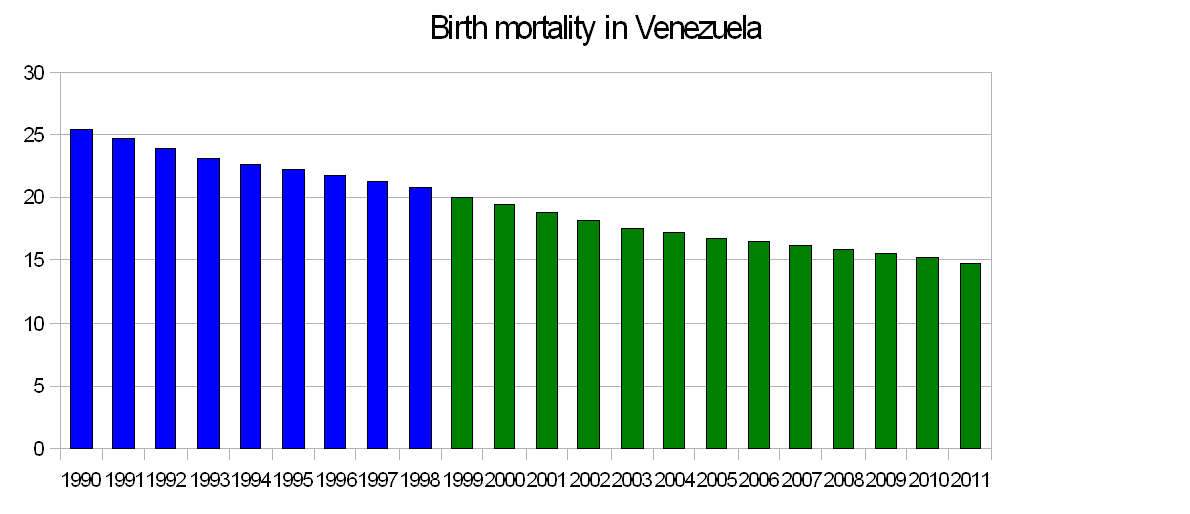
One of the things the Venezuelan government likes to boast the most is how child mortality has gone down since 1999. I am more than happy about that. Still, I wonder: was that not to be expected? I just took the official statistics from the government INE site (2010 is a forecast, I suppose) and plotted them here. In military green you see the Chávez period.
Below you see the reductation rate across the years. From red you se how fast child birth keeps going down.

I let you interpret the numbers. It would be interesting to compare the evolution with other Latin American countries, like I did when we put the Human Development Index in perspective.


Pre-Chávez progress, reduction of child mortality per year
-2.99    -3.09    -3.19    -2.08    -2.12    -2.17    -2.22    -2.27
Chávez's government, reduction of child mortality per year
-3.09    -3.19    -3.3    -3.41    -3.53    -1.94    -1.98    -2.02    -2.06    -2.11    -2.15    -2.2


Saturday, 22 January 2011

The alternative forces at the Venezuela's National Assembly


If you speak Spanish, you can watch María Corina Machado, the one the military regime considers as CIA-agent.

She quotes from state sources and shows how the regime contradicts itself in the most pathetic way. She also goes into very clear detail to dismantle the shameless propaganda about health and education and housing and employment.

Bravo for Corina.

Ps. You can read my latest post (en español) on how the Chávez regime misses a big opportunity to support national sustainable development with the housing projects that now only foreigners seem to be able to perform.


mariacorina
envoyé par noticias24. - L'info video en direct.

Tuesday, 4 January 2011

Ein erdöl- und bettlerreiches Land und sein Gesundheitssystem


Valencia, Venezuela
Das allgemeine Krankenhaus ist - glaubt mir - nicht so bunt.


Was Notitarde berichtet ist eine Situation, die schon seit einigen Jahren zu Normalität geworden ist. Das einzige öffentliche, allgemeine Krankenhaus in der Millionenstadt Valencia hat kaum Medikamente. Das ist so in fast allen Krankenhäusern im Lande und in den meisten "centros de salud" (die keine echte Krankenhäuser sind). Nur die Potemkinzentren, die die Chávez-Regierung für Propagandazwecke benutzt, scheinen richtig gut versorgt zu sein. Das Problem ist nicht so sehr fehlendes Geld, sondern vielmehr, dass vieles gestohlen und das von den Leuten ganz oben nicht nur "toleriert" wird. Diese Situation ist immer schlechter geworden. Und nun sieht man auf den Strassen vor dem Krankenhaus unzählige "trabajadores informales", illegale Strassenhändler, die die Regierung als Arbeitstätige - also nicht Arbeitslosen- zählt, mit Einmalhandschuhen, Verbandsmaterialien und vieles mehr im Angebot. Eine Strassenhändlerin erklärt: "dies gibt uns bessere Gewinnmargen, als alle andere Produkte". Na, Sozialismus pur.

Währenddessen kriegt Venezuela Besuch von einem der wichtigsten kubanischen Bonzen, vom achzigjährigen José Ramón Machado. Der Mann, Vizepräsident der kubanischen Diktatur, besucht für dieses Mal vorbereitete Krankenhäuser, wo die kubanischen "Ärzte" arbeiten und spricht dann im öffentlichen Fernsehen, im selben Fernsehsender, wo Andersdenkenden nicht frei sprechen können, und sagt, in Kuba will man den Sozialismus nur vertiefen. Was für eine Farce.

Wahrscheinlich will Machado Chávez "Vorschläge" geben, wie man mit den Abgeordneten der demokratischen Parteien bei der Asamblea Nacional umgehen kann. Pluralismus wird von diesen Menschen wie die Pest gehasst.


PS. Ik zie dat Alpha ook erover bericht. Je kan dat in het Nederlands lezen.


Sunday, 27 January 2008

Ideas for health in Venezuela

7) HEALTH

This is part of all the ideas for Venezuela in this blog.

7.1. START A GENERAL PROGRAMME ON BIRTH CONTROL:

Venezuela has one of the highest birth rates in South America. The government must carry out a campaign for reducing the growth rate. Among other things, the State must:

  • Organise educational campaigns in all secondary schools regarding birth controls, informing about the huge problems for those girls who get pregnant too early and without a solid financial basis and denouncing how both men and women need to take responsibility for their children.
7.2. MAKE ALL BIDDINGS FOR HOSPITAL CONTRACTS PUBLIC AND THE SELECTION TRANSPARENT:

Whenever a hospital has to deal with a third-party and there is a bidding, this needs to be public and the process must be controlled by authorities that do not belonged to the hospital. Controllers should rotate.

7.3. DIGITIZE THE INVENTORY OF ALL HOSPITAL MATERIAL, MAKE REPORT OF THEFT IN HOSPITALS COMPULSORY:

Right now lots of people are stealing from hospitals: security workers, doctors, nurses. The honest people report the thefts, but the hospital administrators do nothing and the police much less. One should be able to track down the disappearance of material and make the police report on their findings of thefts. National police inspectors and the media should be able to check how many reports of thefts have been followed up.