Wednesday, 12 February 2014

If you want to know who supports the Venezuelan government, look at this


These are the Tupamaros...supposedly "leftist revolutionaries", in reality gangsters. Here you can see how they smash cars' windows and steal from them in an area after they chased away students who were protesting in the area.

These guys will be attacking students today, I am afraid. And the media is not allow to report on the events.


Today's marches in Venezuela


Today a series of  marches are planned in Venezuela. On one side, most of the students and oppositions will take part. On the other, it's Officialdom. Several students have been detained during the last few days for protesting against the government's policies on crime, the economy and the press. Critical newspapers are running out of paper and print paper is imported in Venezuela. 

The state media is already saying opposition leader López is organising violent marches.

The Tupamaros, a group of "left" extremists who are actually armed paramilitary units, will support officialdom in its attacks against the students' marches. 

These marches will take place all over Venezuela.

The government has already ordered the media in different cities not to inform about the opposition's events.

You can read in Spanish here the statement produced by CONATEL, the state authority controlling the media. It says basically that those media outlets informing about "acts that promote violence" would be in real trouble. There is a big banner in front of CONATEL stating "Socializando Las Comunicaciones". In reality that's not really making media more social. It is making them "socialist" in the sense the Castro brothers want.

We will have a tense day today.

I for one think the opposition should focus on creating education networks to inform Venezuelans about what life is really outside the country, about what debates and pluralism mean and how the real economy works.

The economic situation in Venezuela is quickly deteriorating. That's why I consider we should be extremely careful now and avoid getting involved in direct confrontation with the regime. Time will come. We firstly need to fight the brain washing taking place in Venezuela. That should be the absolute focus.


Monday, 10 February 2014

A Venezuelan film wins an award in Spain


"Azul y no tan Rosa" won the prize for the best Ibero-American film in Spain's Goya Awards. You can read about it in Spanish in El País


Friday, 7 February 2014

Venezuela auf Deutsch: Februar 2014


Heute ist wieder ein deutscher Tourist in Venezuela ermordet. Er war gerade auf Margarita mit einem Schiff einer Kreuzfahrt angekommen, er wurde kurz danach zusammen mit anderen Touristen überfallen, er wurde nieder geschossen und ein anderer ausländischer Tourist wurde verletzt. Das ist nichts überraschendes im Land mit der höchsten Mordrate Südamerikas.

Die Wirtschaftslage im Lande wird kritischer, trotz sehr hoher Erdölpreise. Die autokratische Regierung besteht aus völlig inkompetenten bzw opportunistischen Militärs und Linksextremisten, die keine Ahnung von Wirtschaft haben. Venezuela hat nicht bloß einen Finanzminister. Für die Ausübung wirtschaftlicher Maßnahmen hat die Republik zur Zeit 

  • einen Minister für Wirtschaft, Finanzen und öffentliche Banken, den ehemaligen Militärputschist Rodolfo Clemente Marco Torre,
  • einen Handelsminister, den Geographen Dante Rivas, der ein Che-Guevara-Bild über seiner Stereoanlage im Ministerbüro hat 
  • einen Minister für (wirtschaftliche) Planung, Nordkorea-Fan Jorge Giordani - alias der Mönch

Diese drei Minister haben jeweils 4, 3 und 4 Vizeminister.

Die Regierung hat viel mehr Geld ausgegeben, als sie ausgeben sollte und dies äußerst ineffizient.

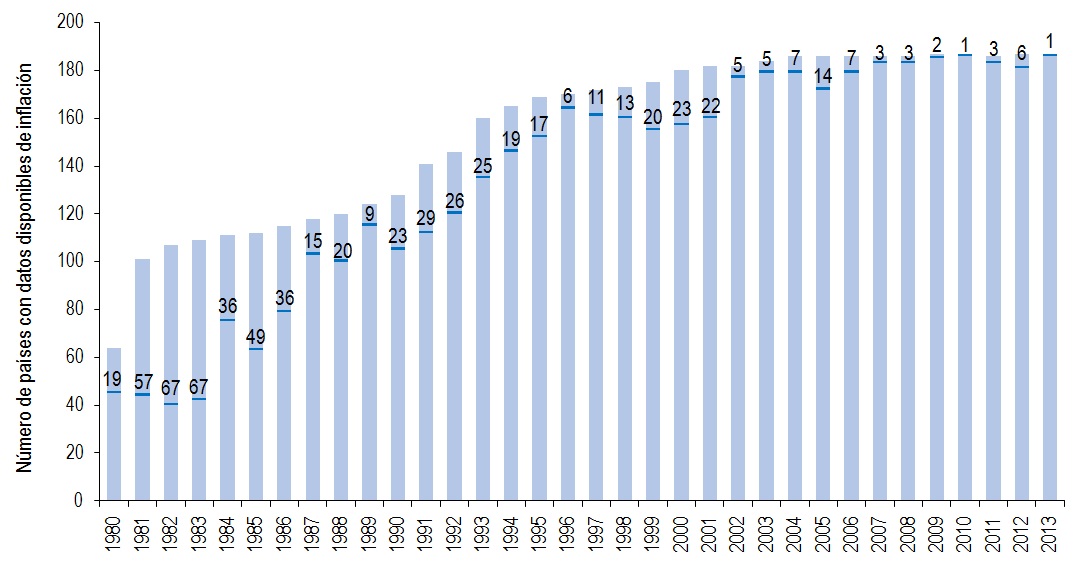
Venezuela im internationalen Inflationsranking. Quelle: FMI - World Economic Outlook Databases (WEO)

Die Währung ist extrem überbewertet und unterwirft einer Kontrolle. Der Staat bestimmt, wer wie viele Dollars kaufen darf. Dies fördert viel Korruption. Die Preise vieler Produkte sind streng reguliert. Das Geld, das die Regierung planlos und ohne unabhängige Kontrolle in die Wirtschaft pumpt, wird kaum zur Förderung inländischer Produktion benutzt und treibt die Inflation weiterhin in die Höhe. Der Schmuggel vieler Produkte zu allen benachbarten Ländern ist massiv.

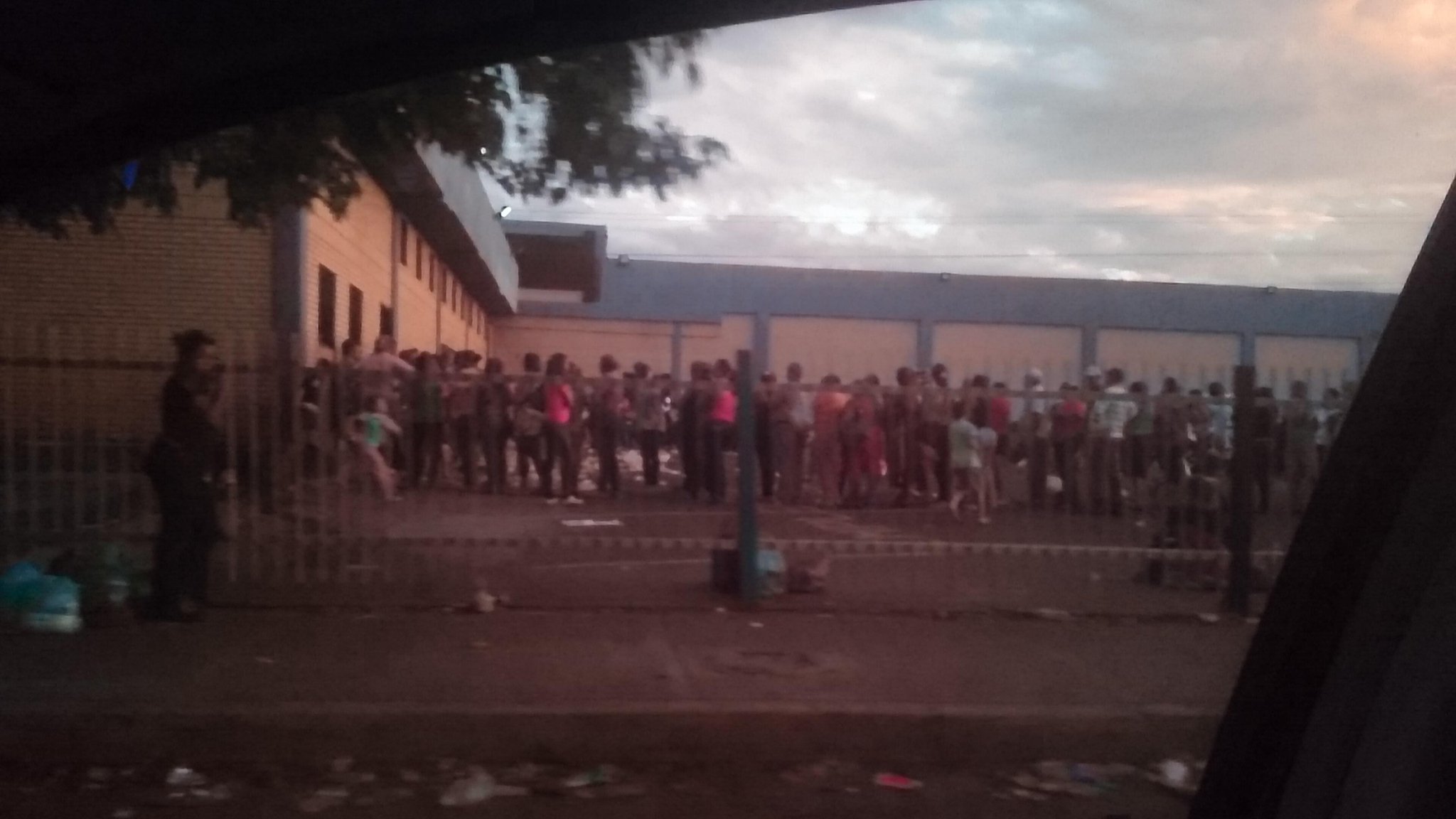
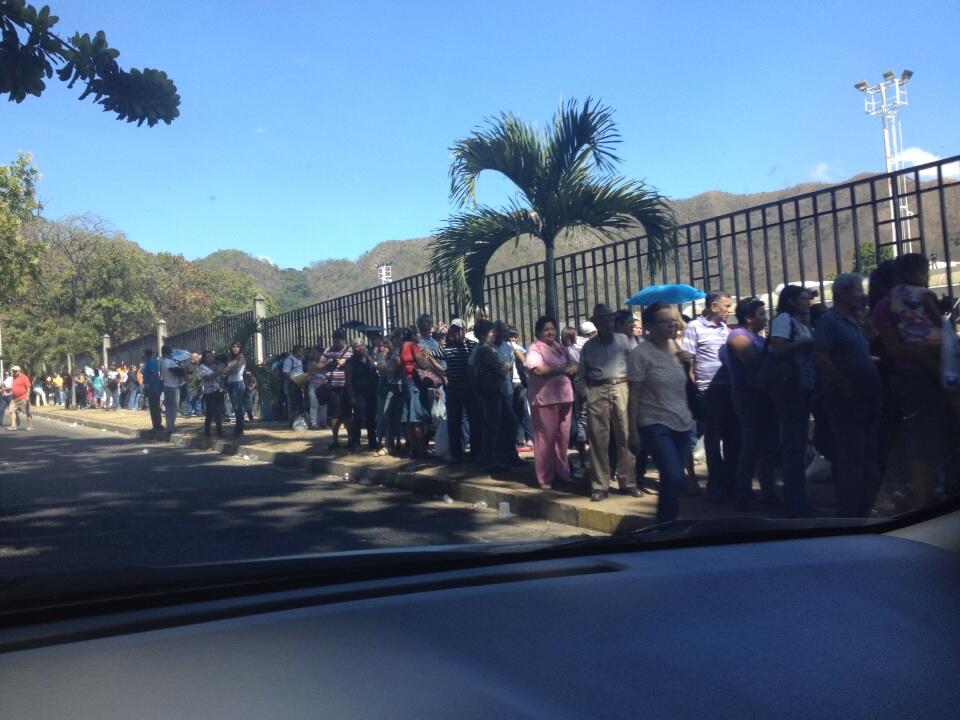
Da darüber hinaus die Dollarreserven immer knapper werden und die Regierung den Verkauf der knapper werdenden Devisen drosselt, fehlt an vielem. Um Fleisch, Mehl, Zucker, Kochöl und Toilettenpapier zu kaufen müssen Menschen überall im Land Schlange stehen. Das war ein seit Jahren immer wieder kehrendes Phänomen. Der Zustand in den letzten Tagen ist in den letzten Wochen aber kritischer geworden.

Hier einige Bilder:
In Caracas (siehe auch Daniels Blog)


In Guayana

In Valencia

Es handelt sich um einen Teufelskreis. Die Regierung importiert wie verrückt. Die eingeführten Produkte reichen aber nicht hin: die Nachfrage ist groß, viel wird weiter ins Ausland geschmuggelt. Viele Menschen der Armenviertel, die keine richtige Arbeit haben - offiziell beträgt die Arbeitslosigkeit nur 7%, in Wirklichkeit arbeitet die Hälfte der Bevölkerung aber im "informellen Sektor" - fahren zu den Vierteln der Mittel hin, wo es bis jetzt genügend Essen gab, um dort nicht nur für den Eigenbedarf, sondern auch für den Weiterverkauf im Schwarzmarkt zu kaufen.

Da die Betriebe kaum Dollars bekommen, um Ersatzteile  und Grundstoffe zu importieren, die in Venezuela nicht hergestellt werden, müssen sie jetzt oft ihre Produktion halten. So hat Toyota ihren Betrieb eingestellt. Die Produktion von Glas wird bald eingestellt - es gibt Gläserbehälter nur für 21 Tage. Danach kann die Produktion vieler Produkte, die solche Behälter benötigen, gestoppt werden.

Die Zentralamerika- und Karibikspiele von Baseball finden jetzt in Venezuela statt. Als Maduro vor ein paar Tagen im Stadium in Margarita war, um ein Spiel zwischen Venezuela und Kuba zu eröffnen, haben viele Menschen ihn und das kubanische Team gnadenlos ausgebuht. Mehrere Menschen wurden festgenommen und sitzen immer noch im Gefängnis. Die Regierung sagte, einige hätten ein Team kubanischer Baseballspieler angegriffen. Obwohl einer der kubanischen Spieler das dementierte, sind die Menschen noch nicht freigelassen. Kleine Proteste gab es in mehreren Städten.

Es gibt Spannung in der Opposition. Immer mehr Menschen denken, dass Henrique Capriles, der bis jetzt der Oppositionsführer war, zu passiv ist. Die anderen bekanntesten Oppositionellen, Leopoldo López und María Corina Machado, reisen, soweit es geht, und rufen Menschen auf, sich für friedliche Proteste in den nächsten Wochen vorzubereiten. Die Nationalregierung behauptet, diese Menschen seien Faschisten.


PS 1: Hier hat Spiegel jetzt über den Mord in Venezuela berichtet


Thursday, 6 February 2014

Venezuela's non-oil sector 15 years after the military came to power


Boligarchs have a lot of chutzpah. They have repeatedly talked about the need to diversify Venezuela's economy, which is hugely dependent on oil prices. They have done so from the very start and the reason is that they knew they had to do it. And their followers nodded and said "how right our leaders are". That's the way to go. That's how Arturo Úslar Pietri said we should go already back in 1937.

Of course, it has all been hot air, like everything this regime has promised.

This chart, produced with data from the Central Bank, shows the dollar value for export of goods from 1997 until 2012. In green you can see the goods related to oil (mostly crude oil). In yellow you see everything else. The share of "alternative" export sources went from 31% of all exports to 4%. That is quite dramatic. One could say this was unavoidable, as OPEC oil prices rose from 12 dollars a barrel in 1998 to something around $104 today. But then even the total amount of dollars from non-oil sources has dropped. We went from exporting 5541 million dollars in non-oil-related goods to exporting 3694 million dollars fifteen years later.


The Venezuelan government is made up of utterly incompetent people whose only skills are 1) their ability to create new dirty tricks to remain in power in a pseudo-democracy and 2) their ability to become rich while ranting about how terrible the capitalist, fascist oligarchs are.

Maduro is replacing ministers and other high ranking functionaries at a faster pace than the deceased military caudillo ever did. He tried one economist as president of the Central Bank from August until January but went back to a mathematician with no clue about economics. He appointed an economist to be the new Minister of Trade in mid January but replaced him two weeks later for a geographer who had been environment minister for some months before.

This is the mess Venezuela is in. This is not new with Maduro but its whole scope is starting to unravel rather fast.


Tuesday, 4 February 2014

Maduro's disarray with the Musical Chairs


We got used to Chávez constantly changing ministers. That was how he infused fear and kept his followers tame. Some of the ministers he removed never came back. Some became opposition or simply outcasts. Some others went to embassies or national institutes. Some kept returning. There is the incredible case of one of his fellow coupsters, Jesse Chacón, who between 2003 and 2013 became, among other things, minister of the Presidency, minister of Telecommunications and Informatics, minister of Science and Technology, minister of Communication and Information (twice) and minister of Justice. Chacón did a couple of other things then as well. He didn't occupy more positions because he had to keep a low profile while his brother Arné Chacón was in jail for a while for becoming billionaire too fast and showing it off too bluntly. Arné is again a free  man and Jesse Chacón is minister of Electricity.

Maduro hasn't been president for one year and yet he has made a couple of rounds of musical chairs. Now we got what might be considered a record: on 15 January he appointed economist and former union leader José Salamat Khan Fernández as Minister of Commerce. Yesterday Maduro announced - using US Twitter- that he wished José well and that he was appointing as new minister Dante Rivas, a geographer who had been minister for the Environment for some months only. 

Call me a sentimental, but I had to capture the moment. Yesterday we had this:


and today we have this:

What do we see apart from the fact he got 20 new followers? Well...yesterday we had

"Minister of the Popular Power for Commerce"
and now:

"Today we have Fatherland. Make no mistake! Today we have Nation. Make no mistake! Chávez lives"

I leave it to psychologists and discourse analysts to ponder on those words. I think there might be something about the fact José realised national production had to increase...and that is not going to happen as long as Maduro is in power. Or am I reading too much into one of his past tweets, when he said he wanted national production to increase?

The way Maduro handled that ministry is just one example. Now, if you want to read more about the new minister that will promote trade (we have lots of other ministers for economic matters), you can read some rubbish in Spanish here or simply look at this picture: the geographer has a Chávez puppet in his (current) work desk and a painting of Che Guevara on top of his sound box.

As for Venezuela's trade and economy in general: I'll write about it on a later post.


Monday, 3 February 2014

Crisis among Venezuelans in Norway


A Norwegian friend told me Venezuelans cannot purchase or legally introduce to Norway the maize flour they need to live.

Apparently, the Harina PAN, which is the maize flour of choice and which Venezuelan POLAR exports now from Colombia to the whole planet, contains genetically modified maize...and Norway is implementing a strict policy of not allowing GM stuff into the country.

This is completely preposterous: it is not like genetically modified DNA from the über-processed Harina PAN packages will get into the maize fields of...Stavanger? Trondheim?

I feel with my compatriots in Norway. I hope the Norwegian government can get to a compromise with the Venezuelan community. The Norwegian oil industry benefits greatly from highly qualified Venezuelans - now Venezuelan Norwegians - who are now without arepas. This is like Muslims without halal or Jews without kosher food. Please, Norwegian government: have mercy upon the Venezuelan community.